|
Walter & Group...
[GH] Clarification from Joe Libeu :
Gordy ,
Much of what is being discussed on the tasks have been discussed and changes have been made to the MCI test. It is not that we do not want to discuss these changes and additions to the MCI test, we would love to but the test has not been sent to the BOG for approval.
Regarding the roll cast tool, it works well and I have used it many times.
As far as " But, if find it easy (using line hand only) to trap around 10 feet line with my rod hand and shot that into the cast. Allowable or not, I don't know but apparently not against the rules."
This would not be allowed, one needs to have all the line out, measured from the reel to the fly and not shoot the line.
Joe
~~~~~~~~~~~~~~~~~~~~~~~~~~~~~~~~~~~~~~~~~~~~~~~~~~~~~~~~~~~~~~~~~~~~~~~~~~~
[GH] Joe, I think many of the comments and suggestions we receive are with the understanding that our MCI and CCI Testing Committees may well be always looking for ways to improve our exams in the future .
Also, they may go a long way to help our examiners have a better idea of some of the concerns and misunderstandings candidates may have as they prepare.
~~~~~~~~~~~~~~~~~~~~~~~~~~~~~~~~~~~~~~~~~~~~~~~~~~~~~~~~~~~~~~~~~~~~~~~~~~~
[GH] From David Diaz :
think Task 6 is much clearer without the stated expectations and the check boxes.
~~~~~~~~~~~~~~~~~~~~~~~~~~~~~~~~~~~~~~~~~~~~~~~~~~~~~~~~~~~~~~~~~~~~~~~~~~~
[GH] Dusty Sprague answers Bernd Zeische's concern over "rearward momentum". His answer prefaced by +++++ in Bernd's message :
Hello Gordy (hello Dusty),
"The back loop may have rearward momentum at the time the forward cast is begun. The back loop shall not exceed one rod length."
+++++ We added the rearward momentum allowance to recognize its importance when casting on water.....the line does not have to come to a dead stop. Of course when casting on grass using an artificial anchor (split tool, pencil/dowel, notebook or other device) or when an examiner stands on the fly, there would not be any rearward momentum.
The back loop shall not exceed one rod length. We added this to help ensure the line would not be tossed back or thrown back, yet allow the candidate to reach back with the rod tip. Its measured from the rod tip.
If on grass or carpet at a fly fair I would ask for an artificial anchor or examiner to stand on the fly and release as my loop passed. I'd begin by drawing the line back into my 'set-up' position, with a D-loop hanging down from the rod tip extended to the rear and held at roughly the 2 oclock position. I'd ask for the fly to be anchored then I'd make the cast ensuring the loop traveled out lower than my head height.
If on water I'd make a long cast to extend the line, slowly draw back into a roll cast position, reaching rearward then without coming to a complete stop, make the forward stroke. The fly will have never left the water, the line will have been reached back a rod length and I will not have come to a complete stop during the cast..
As discussed below, we have added a separate Switch Cast task in the upcoming revision. ++++++++
~~~~~~~~~~~~~~~~~~~~~~~~~~~~~~~~~~~~~~~~~~~~~~~~~~~~~~~~~~~~~~~~
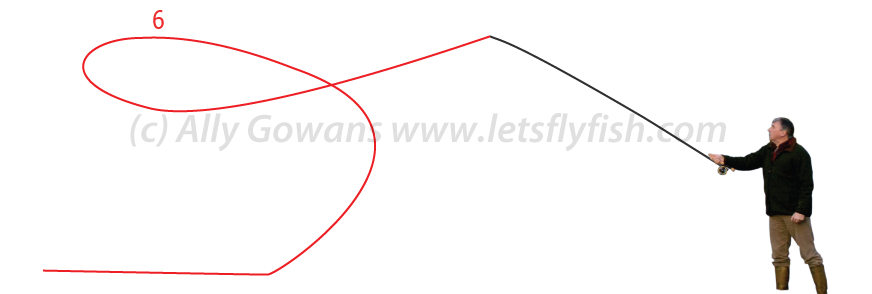
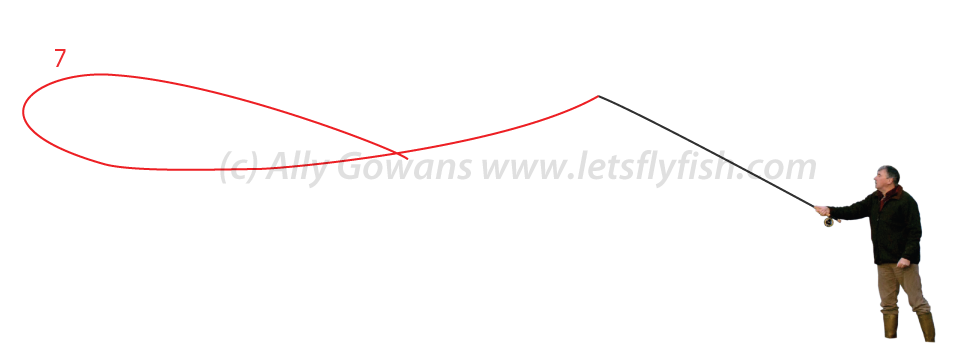
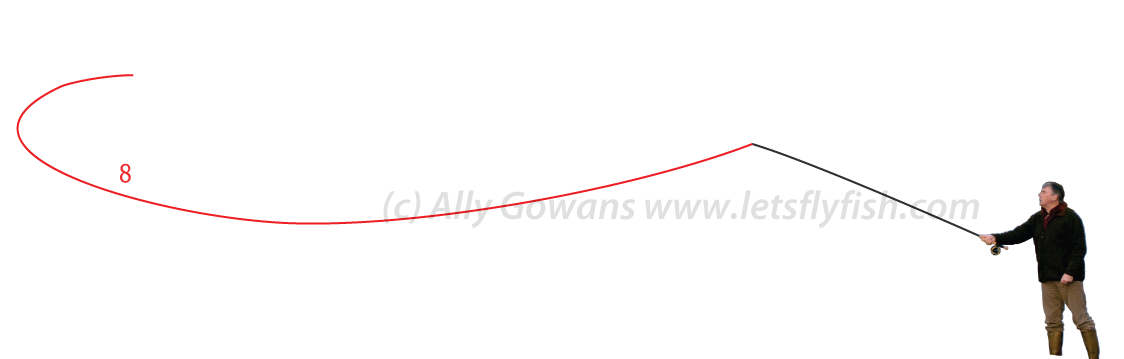
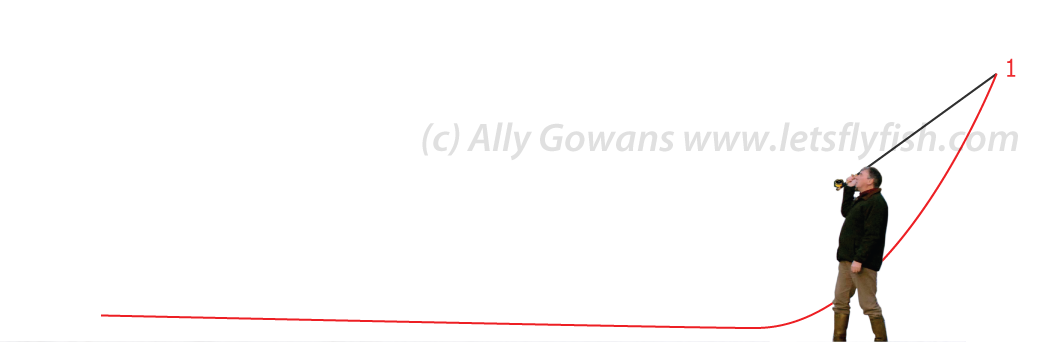
[GH] From Ally Gowans (His 9 attachments should be seen in sequence, 1-9 :
Hi Gordy,
Dusty said Regarding: 'loops no higher than the caster's head'.....this provides a simple and practical approach for judging loop size.
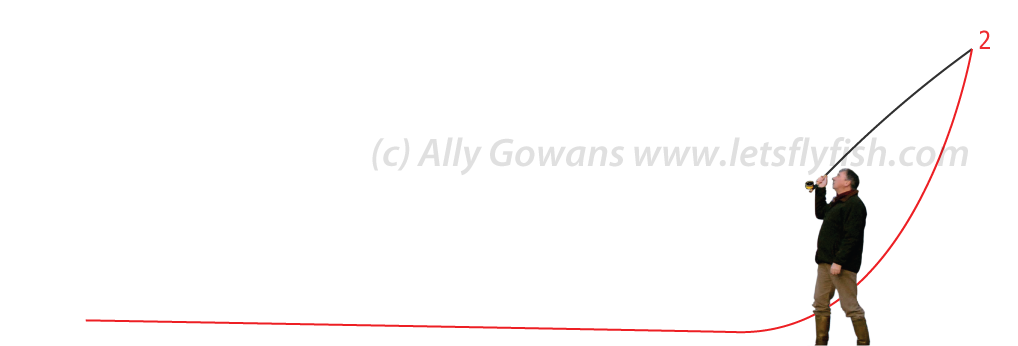
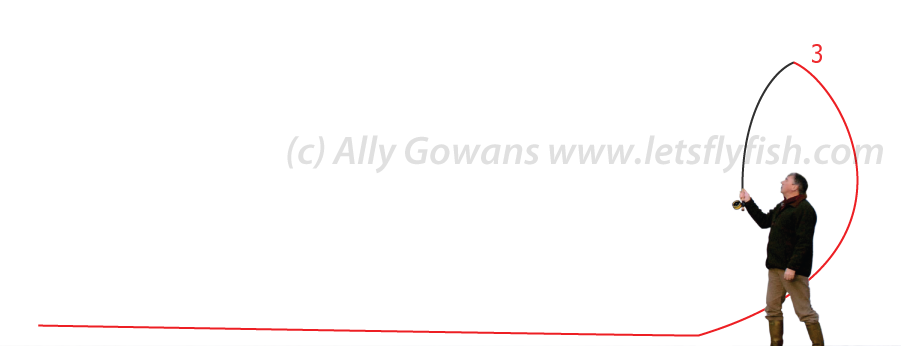
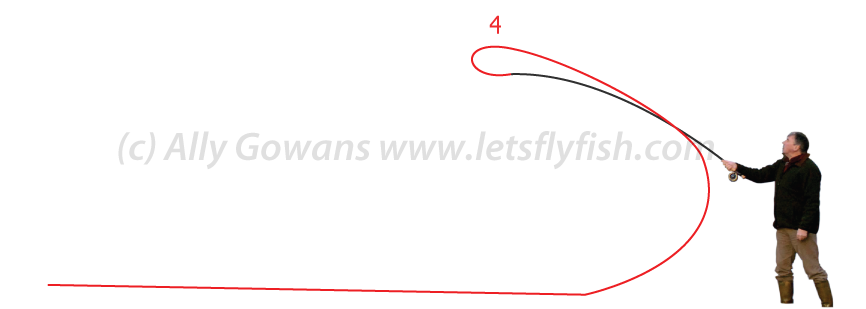
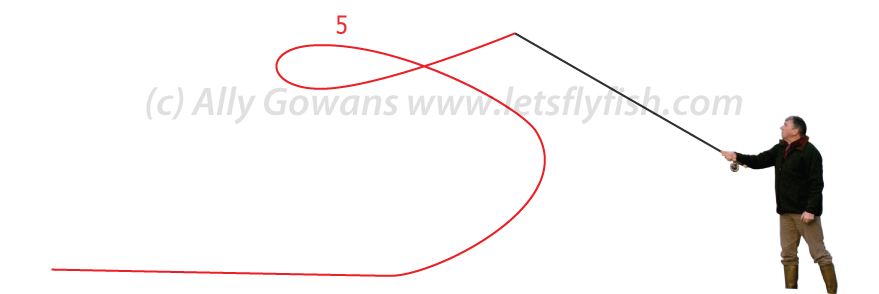
I assume that he means the forward loop and not the D loop. So the question is, how and where is the loop measured? It’s possible to make a loop that is apparently very tight if only the vertical distance between the legs is measured and in extreme cases it’s possible to make the loop appear pointed when it is horizontally wide. Loop width has to be measured in plane to make sense and in a roll cast loops start much smaller than they complete and nothing can be done about that. For a good roll cast all the line should be airborne until the leader is fully extended.
As tight a loop as possible will form when rod tip path is as near as possible to the straight line tangential to the D loop at the launch point. It’s perfectly possible to make tight forward loops above head height and to make wide loops below head height.
According to the rules the pictures illustrate a sequence of photographs from a roll cast that would fail. Maybe someone would like to contribute a series of photos from perfect Task 6 Roll cast for comparison?
Best wishes,
Ally Gowans
~~~~~~~~~~~~~~~~~~~~~~~~~~~~~~~~~~~~~~~~~~~~~~~~~~~~~~~~~~~~~~~~~~~
[GH] Ally, I'd have passed that roll cast.
~~~~~~~~~~~~~~~~~~~~~~~~~~~~~~~~~~~~~~~~~~~~~~~~~~~~~~~~~~~~~~~~~~~
[GH] Question and discussion from Walter Simbirski :
What does "The back loop shall not exceed one rod length" mean? I know the committee has an extremely difficult
task with wording that will satisfy everyone and I also know that they are working very hard to clarify things so I hope
this isn't seen as criticism but I don't have a clear sense of what this statement means. Partly because I don't have
a clear understanding of the term "back loop", in particular where does it begin and where does it end. This could
be taken to mean that the total amount of line in the back loop should not exceed the length of the rod (which is
actually physically impossible in my opinion), it could mean that the point or rounded end of the loop can not
be more than a rod length from the tip of the rod (in which case I would have to ask how far am I allowed to
reach back with the rod tip?), or if I want to be really obtuse I could say this means that the width of my loop
cannot be more than 9 feet. Add this to the fact that there is no restriction on the movement of the candidate,
i.e. I can take a step back while establishing my back loop and this would give me an extra 3 to 6 feet of
lateral movement of my rod tip and then I can step forward when making the forward stroke giving myself
a distinct advantage over someone standing still throughout the cast.
I also have some difficulty with the idea that "The back loop may have rearward momentum at the time the
forward cast is begun" but that I can be failed for a "Thrown back loop". My difficulty here is in understanding
how I can have rearward momentum in my back loop without throwing the back loop. This seems to be
contradictory to me.
If we want the task to be identical for everyone then perhaps what we should do is have the candidate
stand at the end of the tape measure while we stretch their line out to the 55 foot marker and then put their
fly in the anchor at some fixed distance (say 30 feet), let the candidate make their back loop whatever way they
want (walk it back, flip it back, drag it back, whatever) and then return to the starting position with their feet
at the end of the tape measure, get into the key or set position and freeze until told by the examiner to make
the cast.
Another option is to make the roll cast with a building or other obstacle 15' behind you.
Yet another option is to get looser rather than tighter with the definition and tell the candidate they can do
whatever it takes to make the cast with the restriction that at the start of the forward stroke the fly must be
on the ground and it must be in front of the caster.
The difficulty with putting bounds on some of these tasks reminds me of the sport of weightlifting roughly
30 years ago. Up to that time there were 3 lifts (press, snatch, clean and jerk) that were included in
competition. The press was meant to be performed with arms only but competitors realized that they could
use other body parts to aid with the lift (back, stomach, and legs mainly) until the lift began to resemble
the clean and jerk rather than the press. The international body governing the sport tried for years to
restate the rules of the lift with greater rigidity but competitors always found a way to circumvent the rules
no matter how rigidly they were stated. Eventually the body was forced to remove the press from competition
and today weightlifting competition consists of only two lifts - the snatch and the clean and jerk.
Unfortunately we don't have the luxury of being able to eliminate something as essential as roll casting
from the test but I think we may be able to learn from past history. I think we need to think about what
we are asking the candidate to demonstrate and I think they should be demonstrating that:
1. They can make a roll cast to a specified distance
2. They know the difference between a roll cast and a switch cast
Walter
~~~~~~~~~~~~~~~~~~~~~~~~~~~~~~~~~~~~~~~~~~~~~~~~~~~~~~~~~~~~~~~~~~~~~~~~
[GH] Walter,
I think most of us have a pretty good idea of what the wording and expectations for Task 6 mean ....Or do we ?
Then I think that candidates may interpret some of this very differently which can result in serious misunderstandings when the candidate is flunked and really doesn't know why. He's practiced it for years and thinks he's perfected it and then because of technical things such as you describe, he is not successful and disillusioned.
That is why we need diagrams and (eventually) video renditions. I know the committee is already planing to have them.
~~~~~~~~~~~~~~~~~~~~~~~~~~~~~~~~~~~~~~~~~~~~~~~~~~~~~~~~~~~~~~~~~~~~~~~~
[GH] From Lewis Hinks :
Hi Gordy,
Re. Dusty's comment about a Switch cast. Is that not essentially what is expected in Task 7, except a haul is added.
The expectations section of that task certainly look like a Switch cast to me, but I could be mistaken.
Lewis
~~~~~~~~~~~~~~~~~~~~~~~~~~~~~~~~~~~~~~~~~~~~~~~~~~~~~~~~~~~~~~~~~~~~~~~~~~~~~~~~~~
[GH] Lewis,
We'll get to that next.
The term, "flick lift" does suggest a switch cast, but since there is no mention of a "splash & go" anchor placement or alignments of D-loop, Anchor and target ....it is not the same thing, as I see it.
~~~~~~~~~~~~~~~~~~~~~~~~~~~~~~~~~~~~~~~~~~~~~~~~~~~~~~~~~~~~~~~~~~~~~~~~~~~~~~~~~~~
|
Attachment:
gh2_roll cast 2-3.png
Description: PNG image
Attachment:
gh3_roll cast 3.png
Description: PNG image
Attachment:
gh4_roll cast 4.png
Description: PNG image
Attachment:
gh5_roll cast 5.png
Description: PNG image
Attachment:
gh6_roll cast 6.png
Description: PNG image
Attachment:
gh7_roll cast 7.png
Description: PNG image
Attachment:
gh8_roll cast 8.png
Description: PNG image
Attachment:
gh9_roll cast 9.png
Description: PNG image
Attachment:
gh1_roll cast 1.png
Description: PNG image