[Date Prev][Date Next][Thread Prev][Thread Next]
Thread Index
Date Index
Subject Index
Fly fishing questions and info.
- Subject: Fly fishing questions and info.
- Date: Fri, 26 Mar 2010 16:51:51 -0400
Walter & Group...
Questions and information from Walter
Simberski. My comments in italics.
G. :
Hi Gordy,
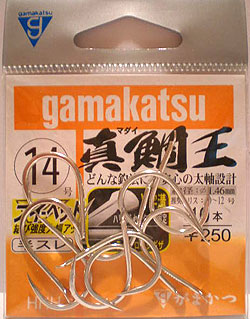
A friend just got back from Okinawa where he
purchased some hooks for fly tying. We were trying to figure out how
the
hooks were sized. Here is a picture I found of some
of the hooks he bought:
(I placed your picture in an
attachment.)
The pack is about the same size as we would buy
from a fly shop in North America, i.e. about 2.5" by 3". These
are supposed to be size 14? I don't think I'll be
tying any size 14 dries with these... :)
Relating the hook bend
size to that of the package, I would estimate that using our system, these would
be about 6/0 to 7/0 hooks.
I'm not familiar with this sizing. Have you got any
information?
I don't. Perhaps
some of our Study Group members can help us with this rating system which is
apparently used in Japan.
Another thing - I've been fishing the Bow River
with a number of people who are using double hand rods lately. We are
noticing that since
they can cover a lot of water with the long rods that they tend to get a
lot more hits than when
using single hand
rods but that their hit to catch ratio seems to be significantly lower than when
using single hand rods.
We are talking trout fishing with typical fish in
the range of 22". These are people who are experienced fly anglers
and
they agree that they seem to land fewer fish with
the longer rods. I've been speculating that they aren't getting the
same
hook sets as with the single hand rods for a few
reasons - they typically have more line out since they are making
longer casts and the lines are thicker and have
more drag in the water. This amounts to more slack in the line
between
the rod tip and fly making the reaction time slower
and hook set less positive. Also the rods are longer and have more flex
than
the single hand rods. I believe that there is also
more stretch in the lines due to the longer length of line outside
the
rod tip. All this amounts to greater challenge when
landing trout (i.e. not large steelhead or salmon) with the longer
rods.
We found exactly the same
thing in the salt as well as when fishing for Chinook salmon in Alaska !
Hookups were much harder to attain when the long rods were used even when the
distance between angler and fish was about the same. Particularly with
tarpon. I had the distinct feeling that our strip strlke and combined rod
and strip strike resulted in some of the energy being devoted to bending the
long rod and diverted from that used for hook penetration. We've
noted for years that the distance between the angler and the fish makes a big
difference in that the greater that distance the lower the hookup ratio even
when the same rods are used. Without physical proof, it appeared that this
may be due to line stretch..... especially since we were able to increase that
hookup ratio when we used non (or minimal) stretch fly lines and short
leaders.
We also did a "study" on
the use of circle hook flies using no true strike when fishing for small
tarpon in circumstances where we could have sufficient strikes to be
meaningful.
The hookup ratio with the
circle hooks was lower than it was with "J" hooks. However, once a
tarpon was hooked with a circle hook, it stayed "buttoned up" with a higher
liklihood of landing the fish. The strike to landing ratio ended up about
the same with each hook type.
I, also, found the
highest hookup ratio when using flies tied with much smaller light wire
chemically sharpened hooks for our tarpon flies ..... instead of the 3/0 and 4/0
heavy wire hooks of former years, I've gone to # 1 to no higher than 2/0 sizes
even for large tarpon.
G.
Next topic: A couple of separate discussions I've
had about rod bend and arc vs casting distance made me think of
something.
A number of 5 wt distance casters have told me that
they can actually cast farther with a lighter rod (up to 7 wt) than
when using a heavier weight rod. At the time the
discussion focussed around the 170 style cast and strain on the wrist but now
I'm thinking there may be another factor involved -
the ability to maintain a near slp of the rod tip with lighter (also longer)
rods over
a greater casting
arc due to the greater degree of flex in the lighter weight rods. I know
that we use heavier line with the
heavier rod but
I personally find it impossible to get as much bend
in a 12 wt as I'm capable of getting in a 5 wt rod (when casting - not
when
pulling against a large object or fish). I can put
significantly more force into a cast with a 12 wt and get proportionately less
bend
than I would get with the 5 wt. I'm also less
likely to tail with the heavier rod because it is harder to cause a concave
path.
Not sure where I'm going with this - just an
observation.
I think the answer is
that the caster has better CONTROL when using lighter
tackle.
We have had some World
class distance casters who use 5 wt. outfits regularly come here and cast 10 wt.
rods yielding far less than their accustomed distance. As you said, it
becomes more difficult to maiintain that almost straight line rod tip path when
the caster is hefting more weight. This is far less a factor when we have
strong casters such as Steve Rajeff.
Much more of a problem
when a good caster who is used to handling light rods most of the year makes a
trip and suddenly begins to fish with heavy
outfits. G.
One last thing - the topic if slide loading and how
it helps with distance casting. I occurs to me that it helps with timing and
setting up for the
haul on the forward cast when false casting with a long line. To the uninitiated
it looks like a form of creep
(I know that's what I thought when I first saw slow
motion video of slide loading) but the slide load is in the form of drag (i.e.
translational movement only) and the real motive force from the cast is in rotation
so we can afford to drag the rod hand forward
a limited amount and that should not affect our
ability to rotate the rod. By sliding the rod hand forward we close the
gap
between the line hand and rod hand and set up for a
longer haul. We could wait for the line (and line hand) to be pulled
backwards
by the line as it unrolls but this takes slightly
longer and makes it more likely that the line would have time to sag
slightly...
As you know from our past
discussions of this topic, it is a controversial one. However, I think you
are correct. G.
A couple of CDN $.01 worth...
Cheers!
Walter
Attachment:
hooks.jpg
Description: JPEG image