|
Walter & Group,,,,
[GH] Please note the attachments. One of them is from Tim Rajeff's message, below. The other is one I tried unsuccessfully to send earlier. It is a copy of Server Sadik's detailed paper on flycasting physics with a few comments by Ally Gowans in text in red.
~~~~~~~~~~~~~~~~~~~~~~~~~~~~~~~~~~~~~~~~~~~~~~~~~~~~~~~~~~~~~
[GH] Will Turek answers Don Pendleton's question :
"Gordy and Master Study Group,
I am considering purchase of a new digital camera. I would like to get something that could take video that could be replayed on a laptop to review a student's casting. Are there any features to look for that can be replayed in slow motion? I'm not a photography expert so what would this type of feature be called?"
[GH] From Will :
Don,
fps = frame rate per second. the higher the number, the better for slow motion. at minimum 300 fps, though some cameras are now around 1200 fps
shutter speed = as fast as you can get it 1200-2400
low light capability = lighting will be crucial to capturing detail
do a search on google "consumer+video+camera+slow+motion"
make sure the camera will record the video in a file format that can be instantly played back on the computer without having to first "capture and convert" the video into a "friendly" file format. this most likely will require a camera that has an internal flash drive for storage.
W
~~~~~~~~~~~~~~~~~~~~~~~~~~~~~~~~~~~~~~~~~~~~~~~~~~~~~~~~~~~~~
[GH] Jim Gill weighs in on Don Pendleton's camera question :
Gordy,
It's only recently that my brother demonstrated to me what can be achieved with the modern digital camcorder - after a some research I decided on the latest Panasonic HDC-SD600. It uses a video scan disk; the images are transferrable to other recording mediums through an USB interface and a PC; also can direct link to a TV screen. I'm a complete amateur but the features on this equipment are amazing - includes still photos, face recognition, zoom, sound - and much more. I've yet to discover its full potential.
My background is radiology so I appreciate the technology of optimising image resolution and the digital image revolution that has hit our shores demonstrates just how versatile post editing functionality is - wouldn't want to go back to the the almost obsolete - black 'n white plastic. I look forward to getting to grips with this new tool and having some fun and then its down to business and using it as an effective coaching tool - although I'm aware that a live demonstration cannot be beaten. Hope this helps.
Best wishes, Jim.
~~~~~~~~~~~~~~~~~~~~~~~~~~~~~~~~~~~~~~~~~~~~~~
[GH] Tim Rajeff answers this question which, you will recall, came from Jim Gill :
Question from Jim Gill :
"Gordy, As I have no knowledge of the actual design and manufacturing criteria of a fly rod - in terms of how the line rating is arrived at - just what is the difference between a #5 and #6 (or for that matter any other line rating) when it comes to the manufacture of a rod? I agree with Ally it's more to do with casting style and probably the physicality of the angler as to what suits best. As a coach and therefore in a position to advise an angler I'd like to understand some more. There is probably a good tome to read out there .. can anyone advise?
regards, Jim."
[GH] Tim Rajeff's answer :
Gordy,
Thanks for the opportunity to provide my two cents worth and possible answer Jim’s question.
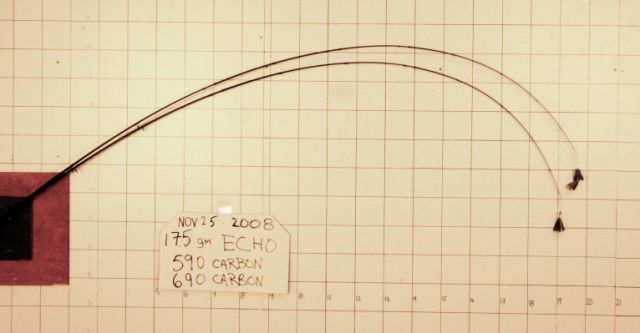
Rod line recommendations are just that, recommendations. When a manufacturer puts a line number on a rod it is only a reference and not an absolute. The overall stiffness of a rod is the main factor when choosing what fly line (and the line’s weight) that best balances with a specific rod. Attached is a photo of my deflection board showing our ECHO 9 foot #5 rod and the 9 foot #6 rod. The grid lines are 10 cm apart and the angle of the fixture that holds the rods is about 33 degreed. With a deflection board it is easy to “see” the difference between different line sizes. We use deflection boards to compare and contrast different rods during the design process.
It has been my experience that 5 main factors control what line recommendation a rod designer might put on their rod. THE factors are; the size of the fly ( air resistance), the weight of the fly, the distance of the cast, expected wind conditions, and finally the expected strength and casting style of the person using the rod. These five factors will dramatically change the rod stiffness rating (line size recommendation) for any given rod.
Considering the five factors listed above you can see how a 9 foot #5 distance casting rod will likely be stiffer than a 9 foot #5 presentation rod. In simple terms the line number on a rod is an estimated “average” for the average caster using the rod in the average fishing and casting situation. So you can see that with many rod companies there is no way to know what you are getting when you buy a 9 foot #5 rod.
In the case of ECHO rods we have designed all but a few models to cast comfortably with the rated line at common distances. To give a person some reference as to the rod’s stiffness I have used my years at the helm of a fly rod to establish what one might consider an “average” stiffness for each line size. Line weights have been standardized for many years when AFFTMA adopted a system of weights that apply to fly line sizes. We use lines that conform to the AFFTMA standard when giving a rod its line weight recommendation.
Assuming a person uses a “standard” floating fly line (one that a modest head length and common front and rear tapers) the “Tim Rajeff rating system” will let a person know what size line will balance comfortable with one of our rods. So if you go to our web site you might see an ECHO rod rated at 5.3; this means that it is just slightly stiffer that a “normal” 5 weight rod. There are other 5 weight rods with different ratings. There are some cleaver systems that have been invented to help rate the stiffness of a rod. You can look for the “common sense method” of rod rating. Might be fun to rate your own rods and then go out and cast them to see how well the match the rating given by your stiffness test.
So until there is a universally adopted rod stiffness rating it is up to the consumer to try different rod / line combinations until they find one that fits their particular casting style and their fishing conditions. For now I think it is critical that all casting instructors, guides, and shop employees test cast rods with several different line sizes at varying distances and formulate for themselves an “overall rod stiffness” rating so they can better help their students choose the best rod line combination.
I hope I have been of some help regarding rod / line ratings.
Take care,
Tim
P.S. nothing I have included in this e mail is absolute or necessarily accurate. It is meant to give your study group a little insight in to the mind of a rod designer / goof ball.
~~~~~~~~~~~~~~~~~~~~~~~~~~~~~~~~~~~~~~~~~~~~~~~~~~~
[GH] Tim....
Thanks for some "real World" info. !!!
~~~~~~~~~~~~~~~~~~~~~~~~~~~~~~~~~~~~~~~~~~~~~~~~~~~
|
Attachment:
590, 690.jpg
Description: JPEG image
Attachment:
FlyCastingPhysics-2010-Rev2.pdf
Description: Adobe PDF document