[Date Prev][Date Next][Thread Prev][Thread Next]
Thread Index
Date Index
Subject Index
Loop shapes / New Topic : CCI vs. MCCI exams
- Subject: Loop shapes / New Topic : CCI vs. MCCI exams
- Date: Mon, 12 Apr 2010 18:15:08 -0400
Walter & Group...
From Bill Keister :
Gordy,
Loops interest me. It took me a while to understand that the fly line
does not go through the loop, the loop goes through the fly line. It is
like the visual effect one gets when a garden hose is swung from side to
side. The stream of water appears to bend. But the water does not
bend. Instead individual drops of water shoot out of the hose nasel in a
straight line. As the hose swings each individual drop is
slightly displaced from the one next. So the 'stream' appears to
bend. In a like manner if a dot is drawn on a fly line that dot does not
travel around the loop. As the dot travels in the fly leg towards the loop
it is traveling horizontally. When it reaches the loop it follow the same
path as point on the rim of a rolling wheel follows (Lefty is right the fly line
unrolls). The dot's trajectory begins to point downward from the
horizontal to the vertical. When it reaches the front of the
loop it's trajectory is downward 45 degrees from the horizontal, not
vertical. As the dot approaches the bottom of the loop its trajectory
becomes more and more vertical until it is exactly vertical as it
comes to a stop at the bottom of the loop. We all know about the kick of a
fly line without a leader. That kick follows the exact path as
every other point on the fly line. The difference is that it is not
constrained by the tension in the line. When it reaches the bottom of the
'loop' it just keeps going. The tip of the fly line did not go through the
loop it just kicked around.
The process just described forms a nice circular loop. Now we are
entering an area I don't truly understand so I am just guessing. I think
pointed loops are formed when we shoot line. Going to the wheel analogy,
the wheel is skidding. In stead of coming to a stop at the bottom (a
stationary rod leg), the bottom point is actually moving in the direction
of the cast (shooting rod leg). Therefore when the point on the line
reaches front of the loop it has moved forward in the direction of the
cast. This means that it has elongated the loop in the direction of the
cast, i.e. pointed. At the bottom of the loop the point never moves
in a totally vertical direction because it comes to rest in and relative to the
rod leg which is moving in the direction of the cast.
When it comes to points on the top and the bottom I am really in a gray
area. My supposition is that it has to do with manipulation of the anchor
point during the stop and variation of power during the final
acceleration. I have read the piece on pointed loops in "Sexyloops" and
have had only spotty scucces in directing the point.
Bill Keister
~~~~~~~~~~~~~~~~~~~~~~~~~~~~~~~~~~~~~~~~~~~~~~~~~~~~~~~~~~~~~~~~~~~~~~~~~~~~~~~~~~~~~~~~~~~~~~~~~~
Bill,
Testimony to the thought that this is a
poorly understood subject is the fact that you are the first to answer the
question on the various loop shapes presented recently.
Your concept of the loop "going through the fly
line" rather than vice versa peaked my interest. I'll have to sleep on
that one. The "drops of water" suggest a parallel with the cycloid
partical path in the Mosser/Buchman Loop Kinematics Diagram and the "coupled
plane pendulae" approach.* This is distinct from the concept of the fly
line loop modeled as a "uniform cylinder in crossflow" by physicist Greg
Spolek. **
Your last paragraph on the manipulation of the
anchor point during the stop along with varying the application of power may be
on target. That would help explain why the only way I can (sometimes) form
a sharp loop with the point at the top is by making a forward and upward
thrust as I stop rotation. Whether that occurs actually before or after
the RSP (Rod Straight Position) I don't know. That anchor point isn't
really established until loop formation, so that makes me think it may be after
RSP.
In the recent past, we've already discussed how
to make wide loops with a high fly leg and a straight rod leg and those with a
fairly straight fly leg and a low rod leg. We can make a "chair shaped"
loop by morphing a rounded loop with a well timed alteration of
counterflex.
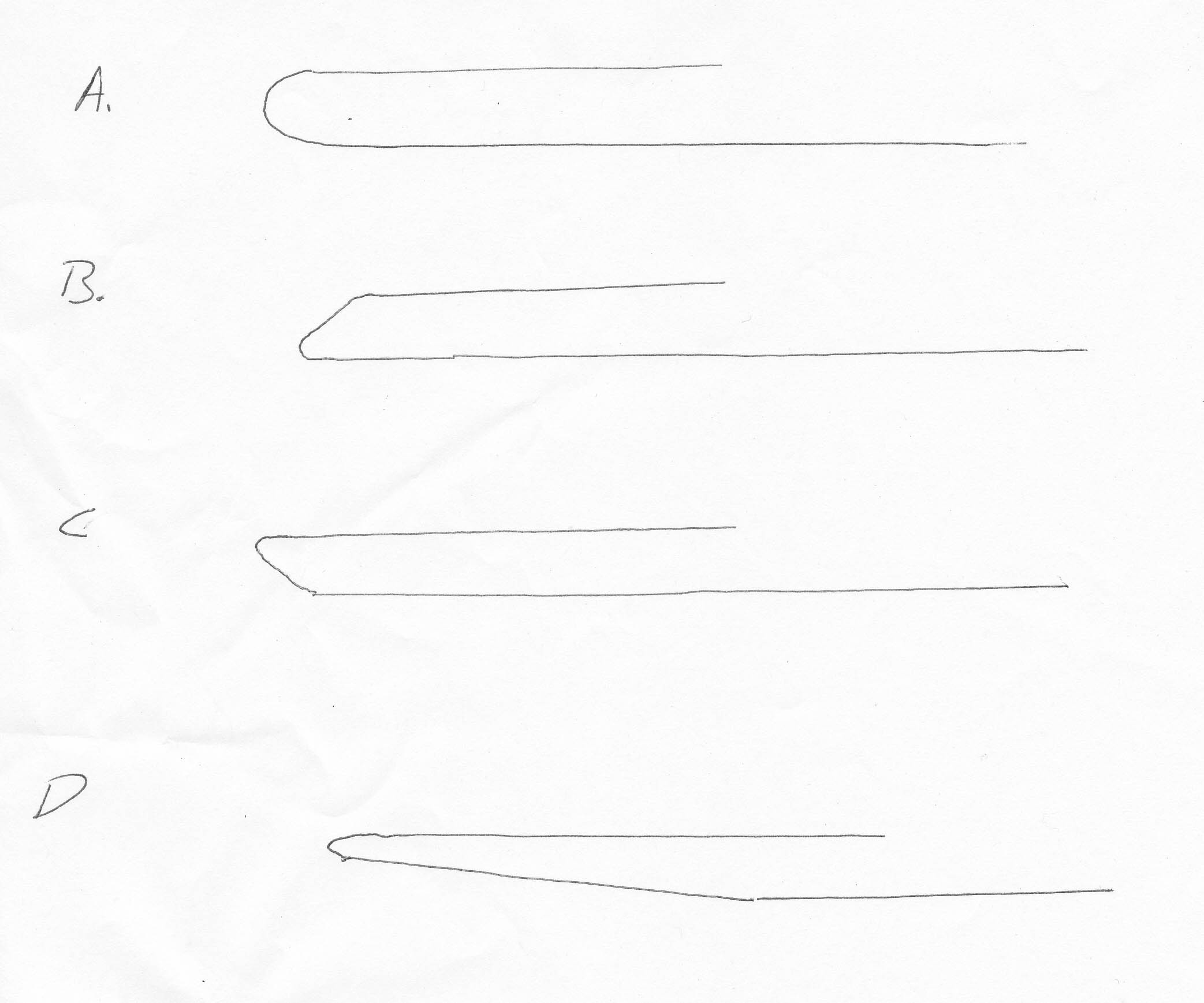
I placed the "loop faces" diagrams again in an
attachment.
I can't form a sharp loop with the point at the
bottom. Not sure I've actually seen that one. ( Loop
b.)
Also, I cannot purposely make sharp loops ( c.
& d.) as distinguished from one another.
If any of you can actually demonstrate those loop
shapes, I'd appreciate your letting us know how you do it.
I asked Steve Rajeff to comment on this.
He's been away.
* THE TECHNOLOGY OF FLY RODS by Don Phillips,
p. 90.
** THE MECHANICS OF FLYCASTING : THE FLYLINE,
by Greg A. Spolek, Am. J. LPhys. 54 (9) Sept. 1986.
Gordy
~~~~~~~~~~~~~~~~~~~~~~~~~~~~~~~~~~~~~~~~~~~~~~~~~~~~~~~~~~~~~~~~~~~~~~~~~~~~~~~~~~~~~~~~~~~~~~~~~~~~~
CCI vs. MCCI EXAMS
~~~~~~~~~~~~~~~~~~~~~~~~~~~~~~~~~~~~~~~~~~~~~~~~~~~~~~~~~~~~~~~~~~~~~~~~~~~~~~~~~~~~~~~~~~~~~~~~~~~~~
Denise Maxwell has suggested a new topic
:
Question: What are
the principal differences you see between the FFF CCI and MCCI exams
?
I think the answers will go a long way in
helping those of you who are MCCI candidates to
prepare.
Gordy
~~~~~~~~~~~~~~~~~~~~~~~~~~~~~~~~~~~~~~~~~~~~~~~~~~~~~~~~~~~~~~~~~~~~~~~~~~~~~~~~~~~~~~~~~~~~~~~~~~~
Attachment:
loop faces.JPG
Description: JPEG image