[Date Prev][Date Next][Thread Prev][Thread Next]
Thread Index
Date Index
Subject Index
Acceleration curves - different perspectives
- Subject: Acceleration curves - different perspectives
- Date: Mon, 12 Apr 2010 16:42:32 -0400
Walter & Group...
The mathematician's viewpoint : Acceleration
curves, exponential, smooth and constant ... from Walter Simberski (I've
included his 2 attachments ) G. :
Hi Gordy,
Sorry I haven't been reading your emails for the
past week. I've been pretty much out of things with the latest flu
bug
that's been going around.
The smoothness and acceleration discussion is an
interesting one. I'll try to answer the easier question first.
Can an exponential function be smooth? From a
mathematical standpoint the answer is yes. In mathematical terms
a smooth function is one for which you can
determine the slope (or derivative) of the line at any point on the line.
In
layman's terms this means that when you look at a
graph of the function it has no sharp corners or breaks in the
line.
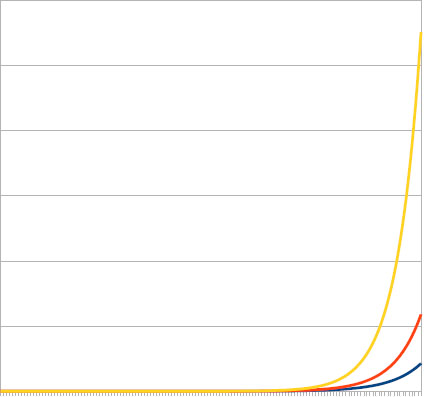
I've attached a graph of some exponential
functions (exponential functions.jpg). As you can see this curve is smooth
from a mathematical standpoint.
From what I've seen of the casting analyzer
smoothness is used in a different fashion. It looks at the chart of
angular
velocity over time during the positive power
application portion of the casting stroke and determines how
straight
the line is or how close the curve is to a straight
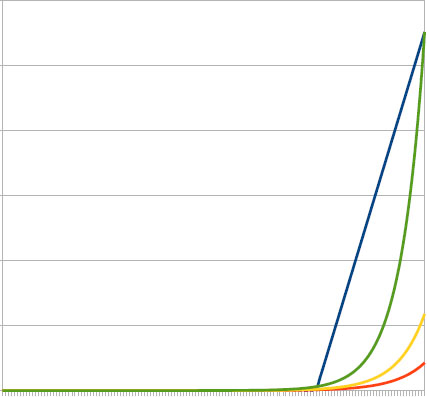
line. I've attached a graph with what we have been calling smooth
(actually constant) acceleration overlaid with the
exponential functions (exponential and smooth.jpg).
Could we define an exponential curve that the
casting analyzer would consider smooth? From looking at the
attached
charts it would be nearly impossible to mistake
constant acceleration for exponential acceleration but I note that
the values used by the casting analyzer for expert
level smoothness are 2.4 and 5.0 so I believe that it would be
possible to apply exponential acceleration that
would fit within the threshhold value of 5.0 for expert level
smoothness
but I would need to know the actual calculation
used by the casting analyzer to confirm that.
Now the more difficult question - is constant
acceleration always the optimal acceleration? In this case we
are
calling optimal acceleration to be that which
causes the rod tip to follow a straight line path. I believe I can shed
some
light on this using mathematics but it is going to
take me a few days to put this together.
At this point I would like to offer some anecdotal information. We know that not every rod is
the same but an expert
caster can adjust to various rods very quickly and
produce expert level casts. This would suggest that, although there
adjustments to be made when changing rods, the
changes are well within the limits of very well ingrained muscle
memory (e.g. speeding up or slowing down stroke,
adjusting casting arc, etc.). Changing the way in which power
is applied probably doesn't fit inside those
parameters. However, I do note that Joan Wulff, who is well noted
for
her ability to adjust to various rods states in one
of her books that she had great difficulty adjusting to a rod with
a parabolic taper. This would suggest that in at
least this one case the rod reacted differently to her casting
stroke
than the majority of other rods. We could write
this off as a case of a poorly designed rod but on the other hand
perhaps we should consider that any rod chosen
should match the caster's natural casting stroke rather than
requiring the caster to spend untold hours
practicing with a rod learning how to adjust their stroke to the
rod.
That by itself could add a whole new level of
complexity to our roles as instructors.
Taking a break for now.
Walter
~~~~~~~~~~~~~~~~~~~~~~~~~~~~~~~~~~~~~~~~~~~~~~~~~~~~~~~~~~~~~~~~~~~~~~~~~~~~~~~~~~~~~~~~~~~~~~~`
Walter... Hope
you get over your flu bug quickly ! Looking forward to your next
message. G.
~~~~~~~~~~~~~~~~~~~~~~~~~~~~~~~~~~~~~~~~~~~~~~~~~~~~~~~~~~~~~~~~~~~~~~~~~~~~~~~~~~~~~~~~
An engineer's perspective, from Bill Keister :
Gordy,
A couple of non-quantitative thought about acceleration. I do not
have any way of measuring the actual acceleration experienced at the rod tip
during a cast. I think that our subjective feelings are effected by a lot
variables which we are unable to account for. One I have
already pointed out. With constant acceleration, during the
first 25% of the stroke, time wise, we move the rod tip through 6% of the total
stroke length and in the last 25% of the time we move the rod tip through
44% of the casting stroke. I think it is difficult for us to differentiate
between acceleration, speed and distance subjectively.
Another is rod angle. During all the discussions of rod angle and how
it pertained to fighting fish I was always thinking about how it pertained to
the cast. Because we have the rod bent double during the speedup and stop
we think we are applying the maximum force. But, we are applying the same
amount of force for the same amount of time for the first 1' 5" of
a 22 foot casting stoke as we are over the last 9' 8" of that same
cast. The rod does not bend as much because it is at a much more effect
angle for transmitting force at the beginning of a cast than it is a the end of
a cast.
Finally, when thinking about rotational acceleration it is important
the consider the effect of rod bending. Rotation predominates during the
speedup and stop. The rod transitions from a more efficient force
transmission angle to a less efficient force transmission angle during this time
period. Therefore, rotational acceleration does not translate directly to
rod tip acceleration. Rotational acceleration has to account for increased
rod deflection which decreases the acceleration on the line.
Bill Keister
~~~~~~~~~~~~~~~~~~~~~~~~~~~~~~~~~~~~~~~~~~~~~~~~~~~~~~~~~~~~~~~~~~~~~~~~~~~~~~~~~~~~~~~
Viewpoints of two highly qualified
instructors :
From Stefan Siikaavara :
Hi Gordy and All!
Thanks Mac! I need to catch up on the board and my
IM:s, just too much casting going on right now, and you know how that is!
(((-:
Before you read this and watch the clips I
want to say something. We do all kinds of flycasting and we do competition
casting on grass. We still have winter so we cast indoors. Competition
casting with light rods looks a bit different from "fishing casting" and not
everything we use has a direct application in fishing (stepping around and so
on). We do however learn a LOT of things with this that helps us as fishermen,
instructors and casters.
I wanted to give Bruce some numbers and
we had a indoor session today but no analyser.
And let me tell you, measuring that light haired guy's (Fredrik) stroke is
downright dangerous with a instrument that has a cable
attached to the rod. You have to run around back and fourth and if you get
your head in the way of his hand your casting days are probably over.
((((-:
I managed to get some clips initially though.
I thought I show you a couple of the competition styles we work on so you all
can get a better picture of why we might get steeper acceleration
and higher smoothness values. No one had a really good day putting it all
togheter today and we are hitting things hangin from the low ceiling all of the
time, but this is still a couple of examples. These are casts from +90
ft carries. Turn up the sound so you can hear the power application and the
line speed.
Best regards
Stefan
~~~~~~~~~~~~~~~~~~~~~~~~~~~~~~~~~~~~~~~~~~~~~~~~~~~~~~~~~~~~~~~~~~~~~~~~~~~~~~~~~~~~~~~~~~~~~~
From Thomas Berggren :
Hi
Gordy,
Have been away for too long and spent too much time for
fishing;-)
However, I?ve tried to catch up this thread and saw my colleague
Stefans questions, and all physic links and math . To be honest I can?t follow
the math here but it seems rational ??.
Stefans Q:
? When I
cast something, a rock, a ball of whatever, I do not feel that the
most efficient way to do it is by accelerating the object in a constant manner?
I think I peak the acceleration pretty clearly exponential once the
cast starts to involve my elbow and wrist joint. Do spear casters
accellerate in a constant manner and how about baseball
pitchers??
BR?s comment:
? ******The reason that constant acceleration is important in
fly casting, and my not be in other types of "throwing", is that we are using a
flexible lever in fly casting. To make tight, efficient loops the rod tip must
track in as straight a line as possible. How the rod flexes is a major
determiner in rod tip path. CA graphs, coupled with high speed video, clearly
show that acceleration that is more constant results in rod bend that yields a
much straighter tip path than acceleration that is more exponential. The
flexible lever is the key, the other sports mentioned don't rely on a flexible
lever so how the object is accelerated is much less critical, although I don't
have specifics on that. BR
?
My relflection:
That?s right we are using a flexible lever and one of the main thing
is to keep a flat tip path. But believe the resistance-change in that lever
isn?t always constant, particularly the ?casting machines? with a very stiff
butt section. It seems to me that the flex in that lever often peaks
(exponential) at the last part of the bending curve.
Just a thought, no math!
So, If I?m consider that it seems rational to me if I have a constant
acceleration to the point where the lever resistance starts to peak, perhaps at
the same point Stefan mentioned: ? I think I
peak the acceleration pretty clearly exponential once the cast starts to
involve my elbow and wrist joint ? and from there go: ?pretty
clearly exponential ? with my acceleration, still without the result of a
?backlash-bend? that destroy my tip path?
I?m just curious if there is some common sense in this thought?
Regards// Thomas B
Thomas Berggren, Certified Instructor
FFF - Federation Of Fly Fishers,
THCI - Two
Handed Certified Instructor.
MCCI - Master Certified Casting
Instructor.
Lilla Malma Fishery
Malma
~~~~~~~~~~~~~~~~~~~~~~~~~~~~~~~~~~~~~~~~~~~~~~~~~~~~~~~~~~~~~~~~~~~~~~~~~~~~~~~~~~~~~~~
Thomas ... Makes sense to me as an
instructor. I don't know if it will hold up to mathematical
scrutiny. G.
Attachment:
exponential and smooth.jpg
Description: JPEG image
Attachment:
exponential functions.jpg
Description: JPEG image