Walter & Group......
John Wilson on the, "climbing loop" :-
Gordon:
For what it's worth it is my personal belief that a
climbing loop is the result of a low back cast.
John
~~~~~~~~~~~~~~~~~~~~~~~~~~~~~~~~~~~~~~~~~~~~~~~~~~~~~~~~~~~~~~~~~~~~~~~~~~~~~~~~~~~~~~~~
John ...
Frankly, I think you may be correct. Following the, "180 degree rule", if we make a low back cast and follow with a high trajectory forward cast, the loop climbs.
We can also do it with an upward curving power snap (vertical curve cast).
Problem is that there are those who believe that the loop can climb even when we cast with both back cast and forward casts made parallel to the ground / water.
I visit this, becuse I really don't know if that is, indeed, possible ..... and if it is, I'd like to know the mechanism behind the phenomenon. We just may all learn something new, here.
Gordy
~~~~~~~~~~~~~~~~~~~~~~~~~~~~~~~~~~~~~~~~~~~~~~~~~~~~~~~~~~~~~~~~~~~~~~~~~~~~~~~~~~~~~~~~~~
From David Lambert:
Gordy,, hey --
Climbing loop thread is very interesting. With a
tip of the hat to Ol' Al's exercise with bead chains: Another more visible
loop and loop morph (with less substantial drag/friction than a floor produces)
can be achieved using Mel's Fly-o (a name M. Lord originated, which Mel did not
whole heartedly endorse, BTW).
Hope to see you all at the Lakeland, FL
FFF expo.
David
Lambert
~~~~~~~~~~~~~~~~~~~~~~~~~~~~~~~~~~~~~~~~~~~~~~~~~~~~~~~~~~~~~~~~~~~~~~~~~~~~~~~~~~~~~~~~~
David... Yes. As you know, Joan Wulff should get the credit for the idea of the, "yarn rod" concept. She called hers, the, FLY-O. Tim Rajeff has come up with another very good variation which is markete via his ECHO company, called, "THE ECHO MICRO- PRACTICE ROD." My own take is that this one is a real advancement on the others.
Using these, however, I cannnot make the loop climb when casting parallel to the ground unless I make a vertical curve.
Gordy
~~~~~~~~~~~~~~~~~~~~~~~~~~~~~~~~~~~~~~~~~~~~~~~~~~~~~~~~~~~~~~~~~~~~~~~~~~~~~~~~~~~~~~~~~~
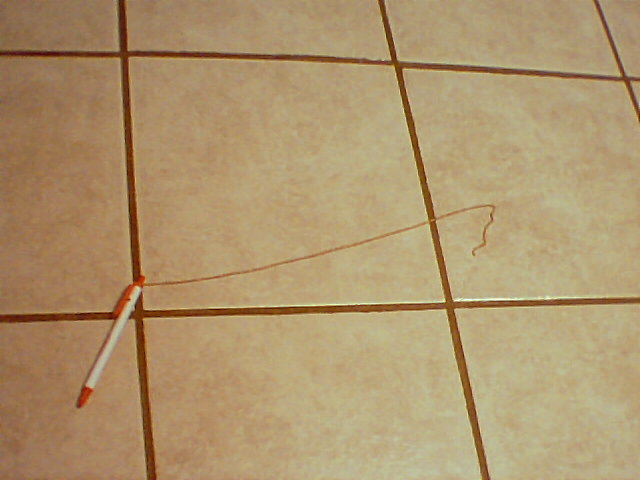
Bead chain experiment, by Al Crise:
More from Ally Gowans on the use of tension in past casting history :
Hi
Gordy,
I am pleased that you
found the Grant piece of interest. Since you mentioned your grandfather’s method
I thought that this might also raise a smile. (I haven’t mentioned the source
because I would have to find the original material in my files to do that).
Another record which he claimed was that of casting 74
yards overhead upon the grass. This being done at
Best
wishes,
Ally Gowans
~~~~~~~~~~~~~~~~~~~~~~~~~~~~~~~~~~~~~~~~~~~~~~~~~~~~~~~~~~~~~~~~~~~~~~~~~~~~~~~~~~~~~~~~~~~~~~~~~~~
Comment by Guy Manning:-
I
had the unique experience of casting a 3 piece, 15 foot Grant vibration made in
the first decade of the 20th century. It belongs to a member of The
Golden Gate Casting Club. The owner brought it to the Spey-O-Rama last year and
let me play with it for a bit. It was kind of an emotional few minutes
because I really felt I had history in my hands.
Unfortunately
we were using a modern 10 wt line on it so it was difficult to know how it
really cast due to the small ring guides that would choke the line. The rod was
in absolutely beautiful shape. All of the original winds were intact and the
finish in good shape. It weighed at least 2 lbs and was very slow and bent all
the way to the handle. What I remember most was that when I stopped the rod it
kept on going… I took some photos of it.
I
personally would love to read anything he wrote.
Guy
Manning
FFF
Master Certified Casting Instructor
Moderator
FFFCCI Yahoo Group
www.castflys.net
Attachment:
photo001.jpg
Description: JPEG image
Attachment:
photo004.jpg
Description: JPEG image