Walter & Group...
[GH] Answers from Bob Rumpf:
Questions on the quick casts made while wading a flat :
1. Name some of the problems encountered when using the quick cast when wading a flat. - When wading storage of retrieved line becomes much more of a problem than fishing from a skiff. Either use a stripping basket or form loops with the first loop the largest (water loop) and each successive loop a little smaller. These loops may be dropped after the first back-cast (freeing the hand to haul) as the speed of the cast should prevent problems.
2. How (if ever) would you change your quick cast method to help solve some of these problems. - When wading you will not be handling as long a line which means you will need to wade closer to your quarry. With the less spooky profile you present as a wading angler and if you add careful stalking it makes this possible. Very important to avoid a high rod angle which may casts shadows. Always cast off vertical.
3. Are there any advantages to wading rather than fishing from a skiff when going for bonefish on a firm, shallow flat ? If so, list them. -With careful wading and proper rod angle you can get much closer to the fish requiring shorter casts. When wading you are able to make quick change of direction cast without worrying about your back-cast threatening others.
4. Are there any advantages to fishing this flat for bonefish from a skiff ? If so, list them. - Easier to spot fish from elevated position, alleviated line storage problems, cover more water and access to creature comforts, drinks, etc.. Four eyes are better than two.
5. When fishing tropical flats, it is rare to have to wade water which is more than mid-thigh depth. Once in a while, we do that for permit in water waist deep. If you did that, how would you modify your line handling and casting methods ? - In this type water it helps to have a stripping basket if not, make shorter loop but leave the first loop long enough to drag in the water
6. You are wading a flat with a tidal current running in a down-sun direction. You have chosen to work in that direction because the visibility is better, and you have spotted a few fish there. -
Would you consider a modification to your casting and line handling technique ? - Here it pays to be extremely aware of casting shadows and by all means avoid a high rod angle, crouching may at times be an advantage. With tide moving away in a frontal direction, allow the line to drag on the surface and use surface friction to load the rod.
Regards,
Bob Rumpf
~~~~~~~~~~~~~~~~~~~~~~~~~~~~~~~~~~~~~~~~~~~~~~~~~~~~~~~~
[GH] Bob,
Agree, even though it is my personal choice to avoid the stripping basket. I have no quarrel with those who use it.
If I've presented to a fish and then strip, I just let the retrieved line loops down in the water. If the fish takes and is off on a blistering run, the line comes up and through the rod guides just fine.... then I have him on the reel.
Gordy
~~~~~~~~~~~~~~~~~~~~~~~~~~~~~~~~~~~~~~~~~~~~~~~~~~~~~~~
[GH] Suggestions from Charlie Shedd:
Dear Gordy When wading the flats, there is a problem that is overlooked. Before you make a cast, make sure there is no slack in the system I pinch the line under finger to the cork. Thus no slack between rod and fly. After first cast be it roll or whatever, I can release line Thus it makes no difference what the line hand does or how much slack is in system I will pinch off line making the first back cast, again eliminate the slack. I also use a series of loops which keep most of line at least part out of water I also mark my line with nail knot or magic marker so that when the mark is in my hand there is 40 feet outside the tip 9 ft. rod, 11 foot leader and 4o ft. out side tip is a 60 ft. cast This will probably be good enough for almost all casts. If I need to shorten, I can because I know where I am charlie
~~~~~~~~~~~~~~~~~~~~~~~~~~~~~~~~~~~~~~~~~~~~~~~~~~~~~~~~~~~~~~~~~~~~~~
[GH] Walter Simbirski wonders about all this ! :
Gordy,
I'm tempted to go on a rant about being subjected to discussions about saltwater. Next we'll be discussing useless stuff like the differences between 3 wt and 12 wt equipment and things like warm and cold water lines, salt corrosion, etc. Like, I really don't have to know all that stuff when I'm located in the Canadian tundra and fishing from a birch bark canoe do I??? What has this got to do with the latest mosquito hatch??? What do I care about avoiding being shark bait when I'm trying to avoid West Nile virus? :)
Sorry - I couldn't resist a bit of humor. Seriously - keep up the great work!
Excellent article by Aitor by the way! Thanks for pointing it out.
Cheers!
Walter
~~~~~~~~~~~~~~~~~~~~~~~~~~~~~~~~~~~~~~~~~~~~~~~~~~~~~~~~~~~~~~~
[GH] Walter ....
Well... we have not yet discussed the intricacies of fly fishing for SHEEFISH (Inconnu) above the Arctic Circle !
Actually, I have done this and I'll bet Troy Miller and a couple of our members have done so, too. However we won't bore the members with that one unless you insist.
No kidding ... years ago we did cover each one of the things you cited including salt water corrosion, warm and cold water lines and casting differences when using extremely light and heavy rods !
We both recall the day you caught your first tarpon with me !
Gordy
~~~~~~~~~~~~~~~~~~~~~~~~~~~~~~~~~~~~~~~~~~~~~~~~~~~~~~~~~~~~~~
Gordy:
Stripping baskets are great for line management when wade fishing in knee deep water. They are however, problematic for line management when wading in waist deep water. The basket will raise up or float thus restricting the motion of the line hand for making long fast strips. Many experienced wade fishers seek other line management solutions as described for this topic.
Salt water fishers must also be careful when releasing fish in the water. The shark in this picture missed my fingers by about a foot while making a quick release of a trout!
Roy Sedge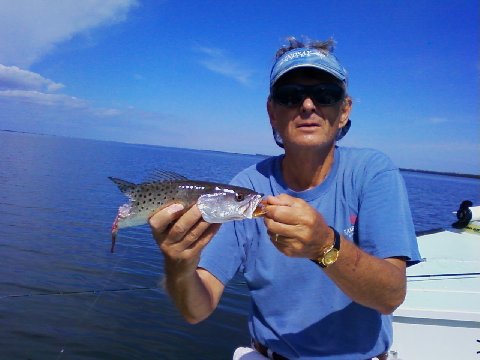
~~~~~~~~~~~~~~~~~~~~~~~~~~~~~~~~~~~~~~~~~~~~~~~~~~~~~~~~~~~~~~~~~~~~
[GH] Roy,
Yes. That is one reason many bone fishers prefer to avoid the stripping baskets.
Years ago, I was wading close to my skiff. The outboard was tilted part way up. As I landed a trout very much like yours, a bull shark came after it. I backed up and cut my leg badly on my own propeller. NOW I WAS STANDING IN A POOL OF BLOOD ! For some strange reason, the shark ate the fish and then left the scene.
Gordy
~~~~~~~~~~~~~~~~~~~~~~~~~~~~~~~~~~~~~~~~~~~~~~~~~~~~~~~~~~~~~~~~~~~
[GH] Question from Steve Smith :
I don't full get this one.To me even if you have a loop in the water, you are holding the line taut in your line hand so the loop after your line hand position would not come into play with loading the rod?
I must be missing something here,if you could please explain.Thanks Steve
"2. If you elect to allow the last (longer) loop to lie on the water, you can use it to increase rod load on the pickup."
~~~~~~~~~~~~~~~~~~~~~~~~~~~~~~~~~~~~~~~~~~~~~~~~~~~~~~~~~~~~~~~~~~~
[GH] Steve,
Good call !! I worded it poorly.
I didn't mean to describe the loops as those held while casting in a stream or river. (Unwise of me to use that description.)
By "last loop" I referred to the largest loop held while wading....the line draped between the rod tip and the line hand.
Two or three small loops are held just long enough so they do not drag in the water. That "last loop" dangling down from the rod tip is held so the belly of it is on the water surface. If a bit behind the caster, he can start with a roll cast. If in front, he can begin with a back cast pickup. Either way, there is a lot more load derived from some "line stick".
Sure glad you picked up on this, Steve. I may have confused several of you with that one.
This morning I took Peter Lami out in my skiff. He was doubtful of this method being efficient until I had him do it from the skiff. Now he's a believer ! (He caught a tarpon this morning! )
This basic method is shown as performed from a flats skiff by Joan Wulff. Her description here.(Highlights are mine) :
"Start the arrangement of the line by holding the fly between thumb and forefinger, then form the necessary loops of the leader and front end of the line on other fingers. Two loops are usually sufficient , even you are short in height. You can trail the bellied line in the water if there are no weeds to obstruct it; that connection with the surface tension will anchor the line to make your first forward move a more efficient one than if the line were hanging freely above the water or, or lying on the deck. " *
Performed when wading, the set up is the same, but only the "loop" described need touch the water, the finger-held loops must be smaller, there is no deck or cockpit, and the casting distance less than when done from the boat.
* Joan Wulff's FLY CASTING TECHNIQUES, by Joan Wulff, 1987, pp. 212, 213 (Drawing of this set up on p. 213.)
Gordy
~~~~~~~~~~~~~~~~~~~~~~~~~~~~~~~~~~~~~~~~~~~~~~~~~~~~~~~~~~~~~~~~~~~
[GH] Lots more, tomorrow.
Gordy