Walter & Group....
[GH] Often, experienced flats anglers will modify the "standard" methods of making the set-up for the quick casts. This could, I suppose, be called .... set-up style. It is done to suit the casters ability and (most often) so that the caster at the ready doesn't fatigue and "go stale" while awaiting an opportunity to present. We have days, for example, when a flats angler might have only 1 to 5 presentation chances in a day ! Sort of like big game hunting where one might spend a couple of days before even getting his quarry in the crosshairs of his scope.
Below, as well as with our next message, are some ways of doing this which work... but are not to be found in the fly fishing texts.
Let me state, again, that these techniques go way beyond information expected on a Master's exam !
Having said that, I feel that if a candidate learns and experiences real and varied on the water fly fishing circumstances over the years, it makes any exam easier to pass. No substitute for answering questions with logic born of actual fishing and teaching experience.
~~~~~~~~~~~~~~~~~~~~~~~~~~~~~~~~~~~~~~~~~~~~~~~~~~~~
[GH] Here is a little trick which my father used to use when wading in water up to waist level :
His casting distance was limited by the water depth. One reason was that he couldn't carry so much line either out of the rod tip or line to shoot out of the reel without a lot of line coils dragging in the water.
He would allow a belly of line/leader of say 15' to lie on the water, behind him as as waded forward. The line to be shot, would be coiled in small "figure eight" coils in the palm of his line hand the same way that some trout fishers do it.... retrieving line with the "hand/wrist twist" method of coiling it in one hand ready for easy release during the shoot.
Tom White did that better than I've ever seen it done. He had very large hands and could hold almost 20' of line in his line hand in palmed fig.8 coils, virtually out of sight!
Years ago, most of the experienced trout fishers I knew used that technique on U.S. NE streams. That is where my father (Pop Hill) and I first learned it. Not in the salt, but while fishing the Esopas (Catskills of N.Y. State) back in the 30's.
Gordy
~~~~~~~~~~~~~~~~~~~~~~~~~~~~~~~~~~~~~~~~~~~~~~~~~~~~~~~
[GH] Holding the fly in hand for long periods can result in unpleasant muscle cramps.
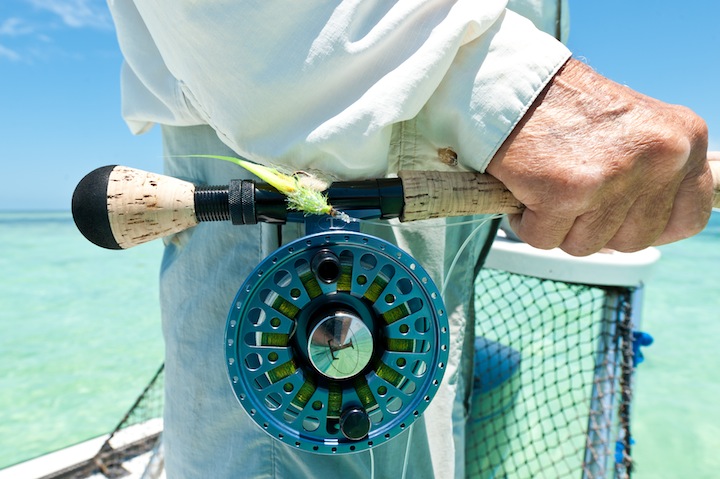
If I'm waiting a long time between fish sightings, I sometimes avoid having to hold my fly in hand by placing it with the hook point in a little disc of Velcro which I've stuck to the back of my reel seat. I don't let the cast pluck it from the Velcro.... too dangerous. I can quickly take the fly to hand just before making the cast :
~~~~~~~~~~~~~~~~~~~~~~~~~~~~~~~~~~~~~~~~~~~~~~~~~~~~~~~~~~~~~~
[GH] That little 1/2" (1.2 cm.) Velcro disc is stuck on top of the reel seat. Never gives a problem. Easily replaced after a season of use.
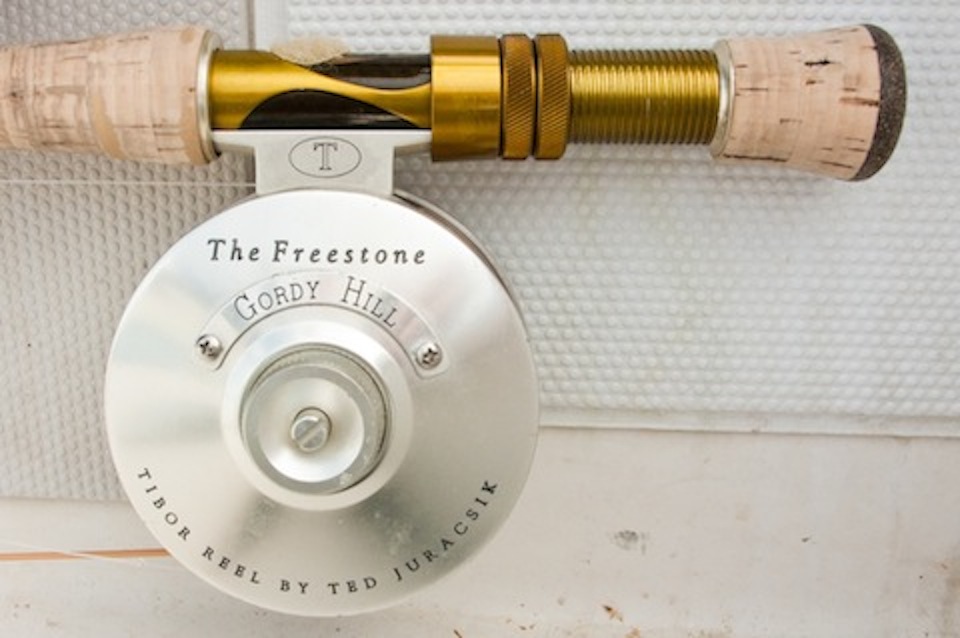
Salt water fly fishers have several reasons for not having metal hook keepers mounted on their fly rods. One of them is that they sometimes use big flies with large hooks. We look at sticking big hooks in the rod cork as a "no no" because after years of doing that it ruins the cork grip.
~~~~~~~~~~~~~~~~~~~~~~~~~~~~~~~~~~~~~~~~~~~~~~~~~~~~~~~~~~~~~~
[GH] At the ready, yet relaxed..... with modified quick cast set-up from the stern. Line coiled on the aft deck between the caster and the net rigged to keep the line from blowing into the outboard engine. Loop of line from the rod tip to the line hand dangling in the clear water. (I happen to be pointing at a storm cell).
The clear line isn't so easy to see with the picture reduced in size.
This is one reason salt water fishing guides in the US and the Bahamas do not like to have clients use clear lines ..... they can't see them well so that makes it difficult for them to coach the angler on how to retrieve as the fish approaches. For inexperienced flats fishers, the on-the-spot coaching by the guide is very important as the method of retrieve (or fly movement) on a second to second basis can make the difference in whether or not the fish is enticed to strike !

[GH] In my "real World" of flats fly fishing, speed of delivery is important..... but often subordinate to maintaining a cool head as the fish is sighted. Often it is best to wait just a bit to be certain to be able to get off a deadly accurate short cast. There must be balance between quickness and calculated deliberation.
Most guides agree that while speed of delivery is important, it is even more important that the angler be able to SEE the fish before fireing off a cast.
When I have an angler new to all this on my deck and his knees knock as he gets as tense as a violin string and nervously holds his breath as a school of monster tarpon approaches ... my biggest job is to try to get him to calm down. If not, nothing good happens !
For these presentations, I prefer a WF steep forward taper/short belly line. I've recently tried the new "Bermuda Short Triangle" line with a short 24' head by Royal Wulff Products. Tim Rajeff (Rajeff Sports) now markets a, "Ridge Clear Tip Tropical Floating Line" by Airflo. This is also a short belly quick load taper design which works well.
Scott Sommerlatte has addressed these salty presentation in a journal article. His statement, "Making slow and deliberate motions is the key to success......" makes sense when accuracy is demanded. *
* In Close Quarters, In the game of sight-fishing, he who has the best short game wins, By Scott Sommerlatte, Fly Fishing in Salt Waters, Vol. 19 #2, Mar./Apr., 2012.
Gordy