|
Walter & Group...
[GH] From Peter Morse:
Interesting subject. I taught my sons how to cast when they were around 7 and 10 and both became reasonable casters but have never fished or gone on with it. I like to think that at least the seed has been sown.
I have taught a few children and would like to pass on the following observations.
Give them a target to cast at, preferably a cap held by one of their parents. If you can involve a parent there is nothing kids seem to enjoy more than trying to impress one of their parents. I have a friend who has 3 daughters, including twins of 9 and a younger one of 7. Dad is a very keen fly fisher and I sat him down in front of them about 20 feet away and they had to land the 'fly' in his hands. If they hit his hand well of course then he fought like a fish. The improvement in the girl's casting was immediate, they had focus and attention and previous lessons meant something as what had been learned had to be applied to get Dad's full attention.
Kids love to learn how to roll cast and they love to be on water.
Teach them tip control and not much else. 'Circles 8's and straights' is a start but I have tip control exercises like 'dragon's backs' and 'tumbleweeds'.
Part of learning to control the tip is trying to write their name in the air with the fly line. These are exercises that can be done when attention wavers.
Get down to their level, sit on the ground with them.
Peter
~~~~~~~~~~~~~~~~~~~~~~~~~~~~~~~~~~~~~~~~~~~~~~~~~~~~~~~~~~~~~
[GH] Peter,
Great tips and observations.
I like the way you handled Dad. Some parents can be a problem when present as we teach. That ploy takes him from being an interrupter and a thorn in your side as well as a distraction for your young student, to an asset !
Gordy
~~~~~~~~~~~~~~~~~~~~~~~~~~~~~~~~~~~~~~~~~~~~~~~~~~~~~~~~~~~~~
[GH] When my grandchildren became older (teens) and more accomplished fly casters, I took them fishing with me at every opportunity.
I learned NOT to make each trip a "lesson". That can be a big mistake!
When they would have a problem, such as wind from the casting side, tangles, tails, etc. I learned to first let them suffer through each problem. Only then did I teach the corrections.
I had learned that many years ago after teaching my younger brother, Mackey, to fly fish. Every time we fished together I corrected his errors and gave him "pointers".
One day I overheard him telling one of his friends that he didn't enjoy fishing with me. When asked why, his reply was: "I just want to fish. Every time I fish with Gordy it becomes a casting lesson".
Gordy
~~~~~~~~~~~~~~~~~~~~~~~~~~~~~~~~~~~~~~~~~~~~~~~~~~~~~~~~~~~
[GH] From Craig Buckbee. I've included his 3 attachments :
Gordy,
Many good thoughts have been sent.
Trying not to duplicate :
As a many times over volunteer and past liaison to the BSA for our NEC - FFF I have taught thousands of
scouts ...literally thousands. Humor and tolerance as well as remembering what it was like to be a kiddo go a long
way, for all involved, to being able enjoy an energy usurping day.
These jamborees have up to 8,000 scouts and all are on a mission to get credit for
activities, as many as possible, add to that the short attention span of these credit seeking "puppies"
and you have a time limiting teaching window. Some, few, actually want instruction. Most just want to
wave that stick that their uncle or grandmother waves - they want to touch it for a few moments and move
on... so be it, who am I to say "No, you must first have a formal lesson, so stand still and listen ! "
A first positive connection to fly fishing is very important - IMHO - and if it means "Here go play with this" for
a few minutes, than that's what it is. All are invited to come back and try again - some do.
Always, the Circle-8s or Spinning the Ice Cream Cone drills are great. For the kids that have an honest hankering
for casting I often tie the line/leader to a driven tent peg and have then throw forward rolls.
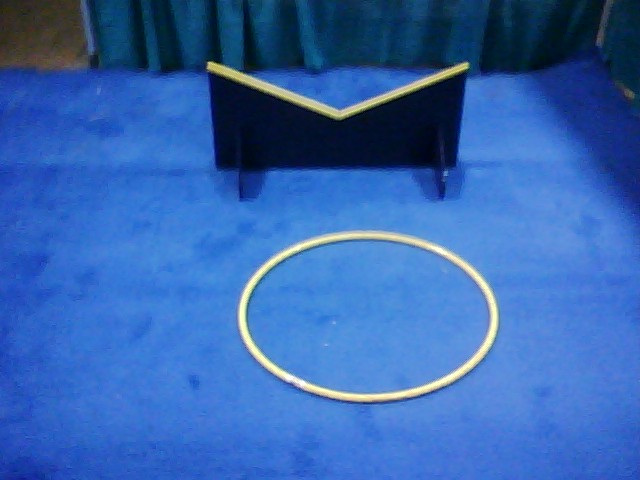
At the winter fly shows, for the past couple of years I have used a device I made up (see attached).... a simple section of plywood or
any sheet material with a sloping section to collect the line and then a Kerf cut to capture the Nail Knot or Yarn ball. They
can be made quite wide so the broad side of the barn can be hit. For semi-accomplished students, the device is quite useful for
teaching the Roll Cast Pick Up & Shoot.
Craig
~~~~~~~~~~~~~~~~~~~~~~~~~~~~~~~~~~~~~~~~~~~~~~~~~~~~~~~~~~~~~~
Craig,
Great advice on starting youngsters ! First approach should probably NOT be a formal lesson of any kind.
Many kids are turned off by the very word, "LESSON". I remember the hatred I had as a young boy for the piano "LESSONS" which my brother and I were made to take. I looked at them as no more than the ruination of many a saturday morning. It wasn't the music which was the problem. I had actually asked to learn to play the trumpet.. It was in the immediate aftermath of the Great Depression, however, and my folks couldn't afford a trumpet. We already had a piano. On my own, I played the nearest thing to a trumpet... my great great grandfather's beat up nickel-silver 1800's era Key of high C, Cavalry bugle !
That roll casting device works ! This is one "roll cast tool" which does not demand that the caster or even an instructor walk out to the tool and set it up after each attempt. Serves a second function as a very practical target to inadvertently teach accuracy, as well !
Gordy
~~~~~~~~~~~~~~~~~~~~~~~~~~~~~~~~~~~~~~~~~~~~~~~~~~~~~~~~~~~~~~
[GH] From Gary Davison :
Rene's comments hit home, Gordy,
Direct teaching of kids is the greatest way to go here being as it keeps the communication and actions simple as Rene has stated.
That is what Al Crise use to provide the kids when he taught them. By keeping the terms simple and something they can relate to. Like up and back to stop 1, forward and out to stop 2 etc.
These simple terms resonated with the students and they could relate to what he was asking them to do.
David Diaz has a great presentation on this direct approach to teaching fly casting. Hopefully he can inject some of his findings with the group on this topic. I attended his presentation at Yellow Stone last year, on direct instruction for kids and for the beginners. He had a great way of telling them to stop the rod for the back cast. He would tell them to pretend that your best friends face is right on your shoulder. Now move the rod rod so it hits him or her on the nose. This would make them stop the rod sooner with out wristing the rod.
These type of analogies help in teach the very young and those beginning to fly cast.
Keeping it simple and relative is very important.
The human wants and needs come into play again Gordy. The desire to learn is a factor as Ken points out.
Gary
~~~~~~~~~~~~~~~~~~~~~~~~~~~~~~~~~~~~~~~~~~~~~~~~~~~~~~
[GH] Gary,
As you know, my favorite of Ol Al's terms for teaching kids was, "ZOOMIES". Instead of telling them to use more power (force), he'd say, "OK...Now use 2 or 3 more Zoomies".
The kids understood him and his special language.
Gordy
~~~~~~~~~~~~~~~~~~~~~~~~~~~~~~~~~~~~~~~~~~~~~~~~~~~~~~~~~~~~`
NEXT: SOON LEE'S METHOD OF TEACHING YOUNGSTERS.
Gordy
|
Attachment:
buckbee device 1.jpg
Description: JPEG image
Attachment:
buckbee casting device 2.jpg
Description: JPEG image
Attachment:
Buckbee casting device 3.jpg
Description: JPEG image