|
Walter & Group...
>From Bob Rumpf. My comments in red italics :
Hi Gordy & group,
I had a few minutes this morning, so I took a quick stab at the quiz. My answers in bold font.
Regards,
Bob Rumpf
VIS-QUIZ
1. As you explain and demonstrate a task, list some of the ways that you effectively lead your student(s) to learn as they observe.- The entire point here is exactly what you have added as your Example. Make certain the cast matches perfectly with the demonstration. If you tell the student to paint a layout with the rod tip, then make sure you are very obviously painting the layout with your rod tip when demonstrating. And of course, tell them to watch the rod tip.
(Example: Your explanation must match your visible demonstration.) - Absolutely necessary to avoid confusing the student.
[GH] Yes. Also: Having the student give feed back on what he sees. Involving them in discussions can reinforce their learning.
2. Sometimes we want the student to concentrate on what he sees the ROD do as we demonstrate. How do you do that ? - The late Tom White used to advise instructors to draw with large crayon. All that is obvious to an instructor can be Classical Greek to a student. Make your demonstrations of faults very visible. Example; leave no doubt when demonstrating creep.
[GH] Tom would use his long index finger as a "rod" before having the student see the motion of the real thing.
Other tricks:
- Use a highly visible demo rod. (Bright yellow, white, etc.)
- Use an unstrung rod for pure rod demos.
- Bend the rod by hand to demonstrate rod actions.
3. Do you use rods designed or modified for teaching to help emphasize this? - Can, but do not find necessary.
[GH] See my comments, above.
4. At other times, we want the student to concentrate on what he sees the LINE do. How do you do that ? - Have them view the line from different angles. Doesn't hurt to ask; Now did you see that?
[GH] Yes. Then follow up with something like: "Tell us just what you did see....".
5. Do you ever use special lines which make it easier for the student to see ? - All lines are bright orange.
[GH] A high viz line is best. Also: The students can see a 7 or 8 wt. line much easier than a 4 wt.
6. How do you have your student learn from what he sees your BODY (arms, hands, body motion) do as you demonstrate tasks ? - As you are performing a particular task, tell the student to watch you and not the line, because you want them to imitate your body movement.
[GH]. Agree. Chuck Easterling once showed us a trick learned from the famous golf teacher and author, Harvey Penick.* The idea is to use the body without necessarily holding a golf club (or a fly rod) and pantomime the stroke as slowly as possible.The instructor does it, then the students do it.
Floyd Franke used a piece of orange tape on the thumb nail of the casting hand, The idea was to, "squeeze to a stop" with the thumb nail aligned with a target.
From Craig Buckbee (I included his attachment):
Gordy,
Back to the SEEING discussion :
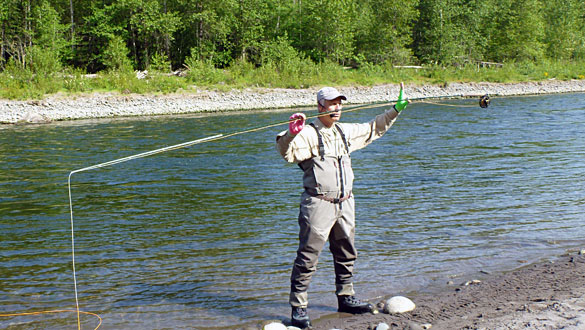
Here's a photo from the Sandy Clave of Al Buhr (teaching spey) wearing a Red glove and a Green glove as teaching props.
Craig
7. What is your method of observing your student's casting to determine whether there is good TRACKING (side to side reasonably parallel loop legs.) - Checking both stroke and line trajectory from all angles.
[GH] Many instructors do that by standing or crouching well behind or in front of the caster. Makes it much easier to see side-to-side deviation of the loop legs.
When hosting an MCI casting exam, I have one examiner do just that.
8. Do you have any tricks to share on enhancing visual teaching effects in the classroom ? - Nothing new, I frequently use just the butt section to demonstrate a proper stroke and have students make the stroke.
[GH] Sure. For classroom use, I learned from Joan Wulff to have one handle from a broken fly rod for each student. Good for teaching grip styles as well. Joan uses her little yarn rod for indoor teaching, as well. (She calls it her, "Fly-O". Other modifications include Mel Krieger's, "Mel-O" and a slightly different one designed by Tim Rajeff.
9. What are some potential visual problems when you are out on a bright sunny day hosting a casting workshop on a field at 9:00 AM during a Conclave (Fair)? - Avoid sun blinding by correct positioning of students.
[GH] That is very important. Better to have the instructor looking into the sun. Sometimes facing North/South will work.
10. What (if anything) do you teach your students about what and how the trout sees? - There is a lot involved here. How the trout's window of vision changes with depth and how that affects the rise-form.
[GH] Yes. Really a detailed subject. An introduction to the basic concepts of, "Snell's window" and the fact that the closer the angler gets to the edge of the water, the more likely it is that the trout will either spook or fail to strike.
11. Do you ever have the student visualize what he cannot see as he presents a fly ? (Hint: Teaching to hover during accuracy casting, etc.) - Yes, examples; invisible drag and lining a fish to name just two.
[GH] Right. Also, casting to an imaginary target to either side of the actual one to compensate for side winds.
12. Do you ever use video feedback technique to show your student what he's doing? - On occasion. But can be valuable.
[GH] Some instructors do use video for feedback. Here is a neat video teaching trick from Thomas Berggren:
Hi Gordy,
Fore the majority of your questions and most of the cases when I teach.. Seeing! I'm using the iPhone application named "SloPro"
It's an video application for your smartphone for filming actions and it plays it in slow motion. I found it extremely useful and it helps me point out specific errors or movements to the students and you can show the student in slow motion directly after filming.
Through all years I have used a regular video camera but that mostly require to go the computer to slow down the speed so the student actually was able to spot the error. SloPro works really well because you can use it out in the field or river and its just you and the student that watch the filming..
Just need your iPhone.
This weekend there was a small Fly fishing fair in Sweden and I had a stand representing my fishery and fly fishing school. I was inviting everyone who wanted to have instruction to correct some if their errors for improving. I called it " the casting lab" and we where three instructors that filmed, analysed and help casters. It was mega popular and the tool is now one of my most helpful tools.
Just check it up on AppStore it's free download.
Best regards//
Thomas Berggren
Lilla Malma Fishery
Malma-Brogetorp
642 96 Malmköping
Sweden
13. Do you ever use a mirror to help teach fly casting? - No, but seems plausible for those who do.
[GH] Joan Wulff used a mirror in the classroom to have the student see his own compound movements of the casting arm while pantomiming a casting stroke with a rod handle.
14. One word description of a fly line loop is: "The shape of the fly line as it passes the rod tip". This may be meaningless to a new flycasting student. Do you have a visual way of demonstrating to this student a fly line loop? - I start all beginning students by laying a loop out on the ground. I form a wide loop, a tight loop and use this opportunity to also form and explain a tailing loop.
[GH] That is the way I do it.
15. Briefly list some important considerations which help students see and understand different loop sizes as you demonstrate them. (Task 1 on the MCI exam.) - Primarily how the loop size corresponds to rod tip movement variations both vertical and horizontal.
[GH] Demonstrating the loops as you cast s l o w l y helps the students see what you are doing and the loops as well.
This is one time when the instructor should consider casting in the vertical casting plane.
Can be followed by having the students make loops as they perform casting over a line on the ground. That way, they can easily see both forward and back loops.
16. We sometimes reinforce our learning with the use of pantomime. Is this mostly learning by SEEING? or is it mainly learning by FEEL? - Both, but due to muscle memory factor, feel is probably more important.
[GH] Agree.
17. Do you ever use the timing for the student's forward cast to help him time the back cast? - Yes
[GH] Works fine, until you get to slipping line.
18. Do you sometimes teach your students to watch their back casts? - Yes if they can do this comfortably, some cannot seem to assume this type stance (wish they all could).
[GH] Difficult to do with strictly vertical rod plane casting. Works best with open stance and off-vertical casting.
19. If you answered YES to #18, tell us how you do that. - I make an attempt to get the student to adopt an open stance, which I explain will be an asset later when distance casting. However I don't force this issue as some people find this uncomfortable.
[GH] In my experience it works well. One problem with using an off-vertical casting plane is that some casters who are used to vertical casting develop out of parallel loop legs until taught how to do it properly.
20. Do you ever use a visual method to teach the relationship between ROD BEND and CASTING ARC for your advanced students? - Yes
[GH] I do.
21. If you answered YES to # 20, briefly tell us how you do that. - I draw several different examples on paper which seems to me to be a good method because it can be viewed at length as opposed to trying to view something in motion.
[GH] Casting with rod bend such that the rod tip follows an overhead straight structure such as the edge of a roof line, etc is one way to do it.
22. Can you provide us with a reference from the fly casting literature on the use of visual HAND TARGET LINES and EYE TARGET LINES as one method of presenting a fly accurately to a target? - You're asking an angling book dealer about books, how apropos. The indomitable Joan Wulff's book; "Fly Casting Techniques" is an ideal source for this type information. There are of course others, but Joan's is a peach.
[GH] Agree. For even more detail, I'd recommend her book on accuracy casting. **
* THE WISDOM OF HARVEY PENICK, by Harvey Penick with Bud Shrake, & Helen Penick, 1997, Pub: Simon and Schuster, ISBN O-684-84508-3.
** Joan Wulff's FLY-CASTING ACCURACY, by Joan Wulff, 1997, pp. 11-15.
TAKE YOUR TIME AND HAVE FUN ANSWERING THESE QUESTIONS. WE'LL ALL LEARN !!!!
Gordy
|
Attachment:
Al @ Sandy.jpg
Description: JPEG image