|
Walter & Group...
[GH] I expected a lot of feed back on my tailing loop message and have not been disappointed. This is how we learn as we gain input from many .... not a single opinion.
>From Phil Gay :
Gordy,
Good stuff!
Over the years I have developed the following technique for correcting tailing loops. I tell my students to get the tip of the rod through the 12:00 o'clock position or an extension of 12:00 o'clock if casting off the vertical before they apply power. I emphasize the tip not the butt as the tip will always be lagging. I demo it with a bent rod to show them how far ahead the butt will be before the tip reaches the 12:00 o'clock line.
This works well when the cause is improper power application related which I think is the cause of most tailing loops.
Phil
~~~~~~~~~~~~~~~~~~~~~~~~~~~~~~~~~~~~~~~~~~~~~~~~~~~~~~~~~~~~~~~~~~~~~~~~~~~~~~~~~~~~~~~~~~~~~~~~~~~
[GH] Thanks, Phil. I'll try that and give it a place in my "bag of tricks."
~~~~~~~~~~~~~~~~~~~~~~~~~~~~~~~~~~~~~~~~~~~~~~~~~~~~~~~~~~~~~~~~~~~~~~~~~~~~~~~~~~~~~~~~~~~~~~~~~~~
[GH] Constructive criticism of my tailing loop message from Guy Manning :
I disagree with some of what you have down on the subject of tailing loops. You state:
Causes : The basic cause of most (though not all) tailing loops lies in the formation of a concave path of the rod tip.
Then go on to say:
Ten Caster movements which can lead to the formation of tailing loops :
1. Erratic or inappropriate application of power.
I feel you have the cause and effect backwards. I feel that the most basic cause is an inappropriate application of power. This creates a concave path of the rod tip. There are numerous ways the concave path can be created at the caster, and some of these are what you have listed. In other words a concave path is not the root cause but what the caster did to create it. A concise way to describe what the body did would be inappropriate application of power. Specifics would be a list of what casters do to create them with their body.
Guy Manning
~~~~~~~~~~~~~~~~~~~~~~~~~~~~~~~~~~~~~~~~~~~~~~~~~~~~~~~~~~~~~~~~~~~~~~~~~~~~~~~~~~~~
[GH] Guy.
Upon reviewing this, I have to agree with you that I have placed the cart before the horse on the titles !
You are correct that the basic cause is always what the caster did in the first place.
Better to have stated it something like this :
Causes : There are at least ten caster movements which can which are the root cause of tailing loops.
Effect : Most (thought not all) of these movements result in a concave path of the rod tip.
I also agree that by far the most common causal caster movement is inappropriate application of power.
There are exceptions which I noted .... such as the tail which forms when the caster makes a back cast and then a forward cast with less than 180 degrees of trajectory between them as well as the purposeful shoving of the rod tip up directly into the line path as well as the failure to dip the rod tip at all at the end of the cast.
One which has been contested, is the tail which occurs when the caster uses too small a casting arc for the amount of line carried. Bruce Richards has stated that this can occur even if the caster does not use inappropriate power. As I think about that one, it seems to me that while this can lead the caster to use a spike of power resulting in a concave rod tip path, it is hard for me to see how the mis-match between the reduced casting arc and the rod bend can actually occur without this faulty power application.
I DO appreciate your critique.
Ill make the change on the master copy.
Gordy
~~~~~~~~~~~~~~~~~~~~~~~~~~~~~~~~~~~~~~~~~~~~~~~~~~~~~~~~~~~~~~~~~~~~~~~~~~~~~~~~~~~~~~
[GH] From Bob Stouffer :
Thank you, Gordy, for the "quick-fixes" portion of the message. I would think of this type of fix as a "short-term" rather than a "lasting" fix. Take the "lengthen your stroke" fix; what is generally needed is more arc.
Bob Stouffer
~~~~~~~~~~~~~~~~~~~~~~~~~~~~~~~~~~~~~~~~~~~~~~~~~~~~~~~~~~~~~~~~~~~~~~~~~~~~
[GH] Bob,
Of course, it IS sometimes the increased casting arc which is needed. The reason I put it the way I did, is that I've witnessed time and time again, guides who use this quick fix saying to the client, " Make a longer stroke ".
Gordy
~~~~~~~~~~~~~~~~~~~~~~~~~~~~~~~~~~~~~~~~~~~~~~~~~~~~~~~~~~~~~~~~~~~~~~~~~~~~~
[GH] From Bernd Ziesche :
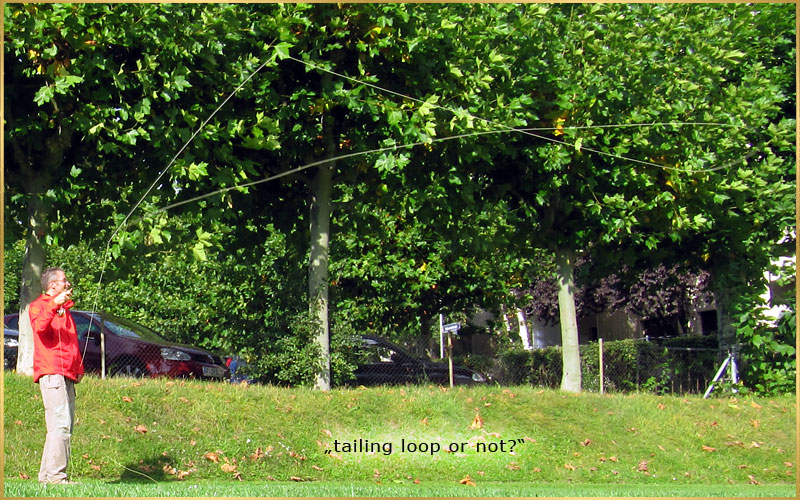
Hello Gordy,great work around the tailing loop, many thanks for sharing all this! Description : - A "closed loop" formed as the fly leg of the loop crosses over the rod leg.
I don't really like this description very much. Attached is a picture that fits well with these description but doesn't show what I call anything else than a nice loop. Chico Fernandez btw is using this loop style in order to drop the fly very softly next to the bones down the keys. That s what I see in his videotapes ;).
Here is another definition that I prefer:
There are many ways how we can achieve a concave path of the rod tip during the stroke. This puts a wave or buckle in the fly-leg of the loop. The tailing will happen when the fly-leg now is dipping down and crossing the rod-leg of the loop.
What do you think?
All the best
Bernd
~~~~~~~~~~~~~~~~~~~~~~~~~~~~~~~~~~~~~~~~~~~~~~~~~~~~~~~~~~~~~~~~~~~~~~~~~~~~~~~~~~~~~~~~~
[GH] Bernd,
I include your attachment.
I must agree that this certainly does look like a "closed loop" and is one example which tells us that perhaps that term is not the best one to serve as a synonym for a tailing loop even though it has been embedded in the fly casting lexicon.
I have watched Chico do this. In the video, you see that the fly leg does not cross over the rod leg; rather it starts low and then rises as the loop unfurls. This is why Chico does not get a collision or a knot.
Gordy
~~~~~~~~~~~~~~~~~~~~~~~~~~~~~~~~~~~~~~~~~~~~~~~~~~~~~~~~~~~~~~~~~~~~~~~~~~~~~~~~~~~~~~~~~
[GH] From Mac Brown :
* Jason Borger's NATURE OF FLY CASTING...., p. 76
~~~~~~~~~~~~~~~~~~~~~~~~~~~~~~~~~~~~~~~~~~~~~~~~~~~~~~~~~~~~~~~~~~~~~~~~~~~~~~
|
Attachment:
BZ5.jpg
Description: JPEG image