Walter & Group...
From Bob Tabbert on the GCC EXPO :
Gordy, If Jim or any other Master or CCI plans on attending the GCC EXPO, please, all come on out to cast at the Sat 10:00 AM Emergency room casting clinic. On Friday 10:00AM I will be teaching a roll casting clinic on the water. I am certain that there will be CCI testing by Tom Jindra and associates! If there is a planned FFF Continued Casting Educational Program, it has been kept a good secret. Th ERCC is an attempt to get more casters out there on the lawn, casting, learning from each other and having fun! The web site for the GCC: www.gulfcoastfff'org contains the details of the EXPO.
Thanks for your help,
Bob
Robert L. Tabbert
Conservation, Fly Fishing, Exploration
Winter:
211 Ursuline St, Lafayette, LA 70506
Summer: N14925,W Turner Lk Rd
Lac du Flambeau, WI 54538
cell# 337 781 3650
~~~~~~~~~~~~~~~~~~~~~~~~~~~~~~~~~~~~~~~~~~~~~~~~~~~~~~~~~~~~~~~~~~~~~~~~~~~~~~~~~~~~~~~~~~~~~~~~~~
Bruce Richards responds to our request for information on obtaining the SA Distance Expert Orange fly lines by FFF Instructors :
Bruce,
Thanks. In my opinion these are the best lines for teaching and for practice as well as ideal for use when candidates take the exam. The blaze orange color contasts well with almost all backgrounds so its easy for the examiners to see. This helps prevent repeating tasks do to poor line visability.... especially when the task may have been perfectly performed the first time.
To FFF Instructors:
Bruce can be contacted at : bwrflylines@xxxxxxxxxxx
Gordy
~~~~~~~~~~~~~~~~~~~~~~~~~~~~~~~~~~~~~~~~~~~~~~~~~~~~~~~~~~~~~~~~~~~~~~~~~~~~~~~~~~~~~~~~~~~~~~~~~~~
SPEY QUESTION
~~~~~~~~~~~~~~~~~~~~~~~~~~~~~~~~~~~~~~~~~~~~~~~~~~~~~~~~~~~~~~~~~~~~~~~~~~~~~~~~~~~~~~~~~~~~~~~~~~~
From Aaron Reimer :
To The Spey Question.
~~~~~~~~~~~~~~~~~~~~~~~~~~~~~~~~~~~~~~~~~~~~~~~~~~~~~~~~~~~~~~~~~~~~~~~~~~~~~~~~~~~~~~~~~~
From Dave Jacobson :
Dear Gordy, Lou and
group,
Some ideas regarding
Lou?s switch rod questions?..
The first step I would
take is to know the grain window of your switch
rod.
On the lighter end of
that grain window, you will have your ?Scandinavian? type shooting heads, using
?touch and go? underhanded casts(single, snake roll, etc) which sounds like what
you have been doing.
Mid grain window, you
will increase head length, thus providing you the capability of ?touch and go?
and sustained/waterborne anchor casts (singles, snake rolls, double,
circle/snaps,). With the increase on head length on a relatively short rod, you
will encounter more casting technique challenges in moving longer and heavier
line with a short lever. A short belly spey would give you a head length in the
40- 55 foot range. Other options would be weight forward ?steelhead/salmon?
lines (50-60 foot heads). A nice compromise would be something like a AFS
Outbound type line (30-40 foot head length). All line choices dependent on grain
weight and casting application. You have the option of a consistent working line
length, as well as
shooting/retrieving.
Top of the grain
window (heaviest) you will go to a short, heavy head (
To use imagery, and
quote Way Yin,
Scandinavian/underhanded
(light and short head) technique is the Ferrari of two
handed casting.
Modern Spey (using
longer and slightly heavier heads) technique is the Rolls
Royce of two
handed casting.
Hope this helps in
some way,
Dave
~~~~~~~~~~~~~~~~~~~~~~~~~~~~~~~~~~~~~~~~~~~~~~~~~~~~~~~~~~~~~~~~~~~~~~~~~~~~~~~~~~~~~~~~
CLARIFICATIONS
~~~~~~~~~~~~~~~~~~~~~~~~~~~~~~~~~~~~~~~~~~~~~~~~~~~~~~~~~~~~~~~~~~~~~~~~~~~~~~~~~~~~~~~~
From Ally Gowans :
Hi
Gordy,
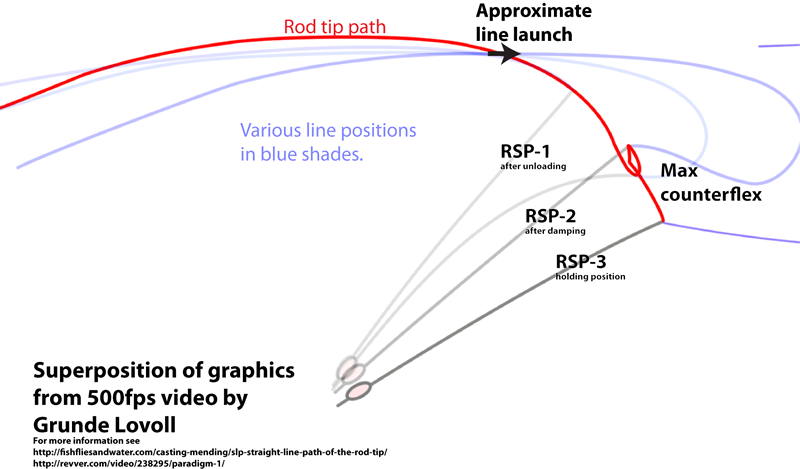
The superimposed sketch that I sent a few days ago was derived from the video by Lovoll but I wouldn?t want anyone else to get the blame of it.
I traced the rod and line positions from still frames after enhancing them and then superimposed the graphics from the sketches which I thinks makes them interesting. The direction of the line is a clear indication of the direction in which the tip must have travelled immediately before the line started to overtake it.
It?s important to
remember that whilst the rod is pulling line the line segment adjacent to the
tip and rod tip are travelling at the same velocity. When their paths diverge
they do so slowly to begin with and during this phase visual detection of the
embryonic loop is very difficult and it is not until later, after the tip
velocity and line velocity are substantially different that the loop becomes
apparent. However the location of the fly leg gives clear indication of the
actual launch direction where the loop must have started to form. The clearest
demonstration of where the line launches is easily observed from a 170 deg
distance cast. In many cases the launch is not far from the minimum cord length
and at around 90 deg to the fly leg direction.
Best
regards,
Ally Gowans
~~~~~~~~~~~~~~~~~~~~~~~~~~~~~~~~~~~~~~~~~~~~~~~~~~~~~~~~~~~~~~~~~~~~~~~~~~~~~~~~~~~~~~~~~~~~~~~~~
Ally...
Attachment:
Lovollssupermiposed_slp_web.png
Description: PNG image