[Date Prev][Date Next][Thread Prev][Thread Next]
Thread Index
Date Index
Subject Index
Casting mechanics
- Subject: Casting mechanics
- Date: Thu, 01 Apr 2010 12:54:19 -0400
Walter & Group....
From Lou Bruno. My comments in his text in
italics
G.:
Gordy,
I
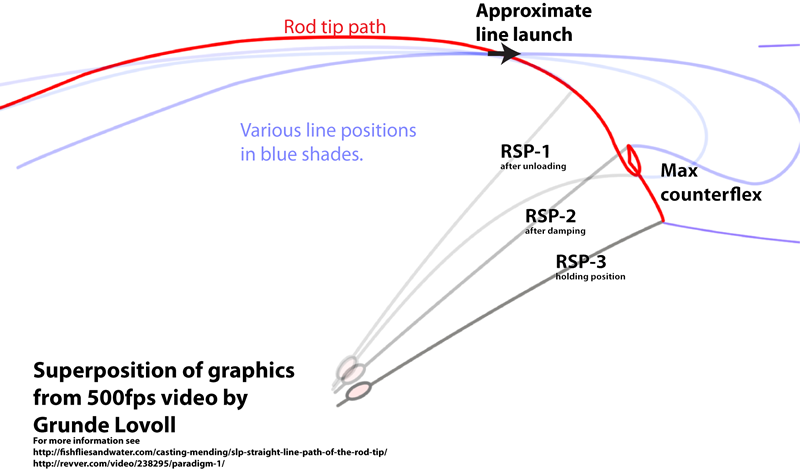
was looking at the Ally?s attachment (picture), I equate RSP-3 with the
completion of the forward cast (follow through). In order to get the rod
in the position for RSP-2 wouldn?t the caster use rod rotation and if so why
would they? Wouldn?t the caster stop the rod, allow the rod to counterflex
and rebound, allow damping to complete, before any further rod
movement?
Not necessarily. As I understand it, RSP-2 was the position
after damping .... I made the assumption that the caster didn't add
rotation.
Ally sent us that overlay diagram ... but it was the work of
Grunde Lovoll. Once again, I included it in the attachment for
clarity.
I
understand damping to mean, the time a rod takes to stop vibrating. Is this
correct, as a caster how can we control damping or minimize it? And if we do is
that a good thing?
The way I see it is that damping is mostly a function of the speed
with which a rod returns to its original position after vibrating .... not so
much a function of what the caster does. Better, yet :
Don Phillips describes DAMPING as "...decay of vibration
amplitude in the absence of any external applied forces."
* THE TECHNOLOGY OF FLY RODS, by Don Phillips, pp. 88 -
89.
Lou
~~~~~~~~~~~~~~~~~~~~~~~~~~~~~~~~~~~~~~~~~~~~~~~~~~~~~~~~~~~~~~~~~~~~~~~~~~~~~~~~~~
From
Soon Lee. My comments in his text in italics
followed by my more detailed answer
:
Hi Gordy,
I am always
the odd man out when there is a discussion on the role of straight line path on
loop size.
You
are not alone, Soon.
I am of the opinion that
straight line path of the rod tip only determines a straight fly leg. It is
essential to throwing a loop with parallel legs but it does not determine loop
size. Straight line path is just as essential to throwing a wide loop with
parallel legs. Just this latter observation alone will refute the statement that
straight line path is the raison d'etre for tight
loops.
Loop size is the result of multiple factors:
1)
extent of rod bend at the "stop", a product of rod stiffness and caster
performance;
Yes.... rod bend related to application of power as well as
stiffness.
2) profile of the rod bend at
the stop (whether rod counterflex is largely directed forwards, or counterflex
is directed more downwards);
3) the degree of abruptness of the stop
(Lefty's speed up to a stop....);
Yes.
4) purposeful manipulation of the
rod tip by the caster at the stop: stiffening up the rod shaft by thrusting
along the axis of the rod (Lefty's stab) moves rod bend distally, shortening
effective rod length with consequent reduced rod bend....Bruce Richards points
out that a shorter rod casts tighter loops. Alternately purposeful, exaggerated
rod rotation at the stop widens loop size.
Agree.
Loop shape has its own
causative factors, but that is another story.
Yes.
Soon S.
Lee.
~~~~~~~~~~~~~~~~~~~~~~~~~~~~~~~~~~~~~~~~~~~~~~~~~~~~~~~~~~~~~~~~~~~~~~~
Soon
:
Well,
a straight fly leg IS needed for a small loop, so one could still argue for a
straight (almost) line path of the rod tip... at least for THIS COMPONENT OF THE
SMALL LOOP.
What
the caster and rod do after Rod Straight Position, largely determines what
happens to the rod leg of that loop.
In
other words, we can have a straight line path of the rod tip for the "start" of
a small loop, then have the rod unload with the tip at RSP close to the oncoming
line and end up with that small loop ..... OR.... the caster can have that
straight line path (SLP) up almost to RSP and then unload finally at RSP well
below the oncoming line and end up with a larger
loop.
Actuallly,
that would be placing some brief increase in convexity of the rod tip path prior
to RSP.
OR...
We
could have a SLP of the rod tip all the way to RSP and unload just beneath the
oncoming line and still end up with a wide loop if we have a great enough
descent of the rod tip immediatelly afterward by virtue of great conterflex
combined with insufficient loop speed to erase ("suck up") the descending wave
produced by that move.
Point
is, I think you are correct that it is NOT merely a simple matter of rod tip
path during the stroke that always ends up determining loop size .... However, I
feel it is usually the principle determining
factor.
Gordy
~~~~~~~~~~~~~~~~~~~~~~~~~~~~~~~~~~~~~~~~~~~~~~~~~~~~~~~~~~~~~~~~~~~~~~~~~~~
Attachment:
supermiposed_slp_web.png
Description: PNG image