Walter & Group....
Here are some great comments from our members. One way we all learn from one another .....the very essence of our Group discussions:-
From Troy Miller:
Rebound can (and
usually does) continue PAST the second crossing of RSP, resulting in a bend in
the rod toward the caster again. This can be seen very clearly in a rod
that does not dampen quickly (such as many low quality glass and bamboo
rods).
Regards,
Troy
Miller
~~~~~~~~~~~~~~~~~~~~~~~~~~~~~~~~~~~~~~~~~~~~~~~~~~~~~~~~~~~~~~~~~~~~~~~~~~~~~~~~~~~~
Troy... After I read your message I did what I should have done in the first place. When you are not sure of an answer, go out and try to duplicate the problem. Sometimes that isn't so easy because some of these more complex events should carry the caveat, "all other things being equal" which they often are not.
I did it using a very soft bamboo rod and found that you are absolutely correct. That rebound with the rod tip bouncing way back beyond RSP was easy to see.
Gordy
~~~~~~~~~~~~~~~~~~~~~~~~~~~~~~~~~~~~~~~~~~~~~~~~~~~~~~~~~~~~~~~~~~~~~~~~~~~~~~~~~~~~~~~~~~~~~~~~
From David Lambert :
Gordy, hi:
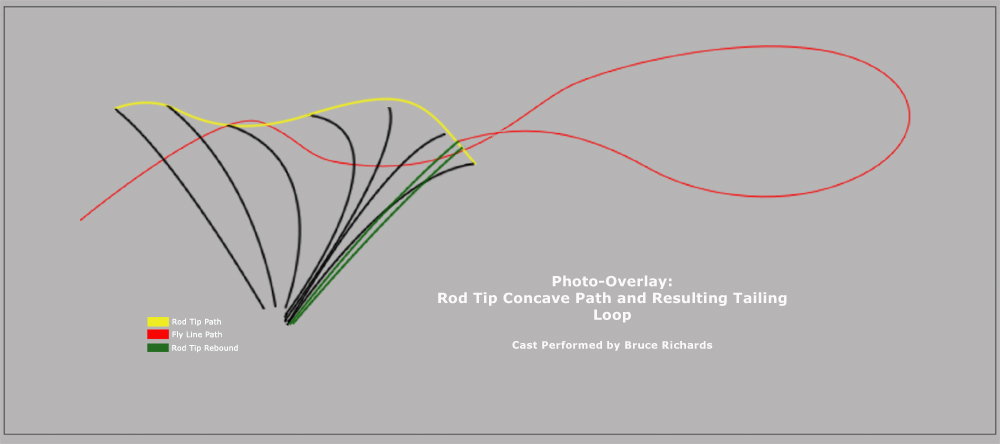
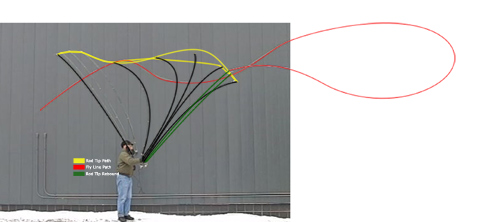
Thought the group might find useful this graphic overlay I
of Bruce (Richards) throwing a tailer. This are the actual positions of rod and
line in a stop-action image. It shows what David Diaz and Syd were
discussing re: 'Sproing' action of tip rising after concave in a tailer. If the
tip just makes a dip and doesn't rise, it's not concavity. I eliminated
some of the overlay so group could see the rod positions overlain with drawn
images.
Hope everyone's New Year glides on great greased grooves (with
apologies to J. Steinbeck).
David Lambert
~~~~~~~~~~~~~~~~~~~~~~~~~~~~~~~~~~~~~~~~~~~~~~~~~~~~~~~~~~~~~~~~~~~~~~~~~~~~~~~~~~~~~~~~~~~~~~
David... Thanks. Those attachments are crystal clear ! Can we reduce Steinbeck's quote to GGG ? (Sounds like an Airflo Ridge Line which has been lubricated.)
G.
~~~~~~~~~~~~~~~~~~~~~~~~~~~~~~~~~~~~~~~~~~~~~~~~~~~~~~~~~~~~~~~~~~~~~~~~~~~~~~~~~~~~~~~~~~~~~~~~~
From John Johnson :
Gordy,
~~~~~~~~~~~~~~~~~~~~~~~~~~~~~~~~~~~~~~~~~~~~~~~~~~~~~~~~~~~~~~~~~~~~~~~~~~~~~~~~~~~~~~~~~~~~~~~~~~~~~~~~~~~~~~
John....
Your assumption is correct.
You got me on this one Gordy:
13.) You just made a high trajectory back cast. Using exactly the same rod plane, you made a forward cast with trajectory parallel to the water. What happened to the loop ? It probably formed a tailing loop, because the casts were made in different line planes.*
It appears to me that in this case there would be less than 180 degrees in the trajectories of the back and forward cast therefore a tailing loop would most likely occur. By NOT changing the rod plane the tip would have to travel in a concave path !
??
Dennis
Dennis
Casting in different line planes (trajectories) be the sole cause of a tailing loop UNLESS THERE IS LESS THAN 180 DEGREES BETWEEN THE TRAJECTORIES OF THE BACK CAST AND THE FORWARD CAST.
I'd add that to make that tail, you don't change rod planes between casts.
If you make the cast with less than 180 degrees between the trajectories of the back cast and the forward cast and you DO change rod planes between these casts, you can avoid the tail.Attachment:
tailing-loopFinal.jpg
Description: JPEG image
Attachment:
tailing-loopPhotoand-Overlay.jpg
Description: JPEG image