Walter & Group...
Description of a fascinating stillwater fishery by Peter Morse :
Gordy and group, I just returned from a week or so in Tasmania which
has many great still water fisheries. The variety of these fisheries
means it would take a lifetime to experience them all let alone master
them. Here are some of the techniques they use there.
Polaroiding -
like bonefishing but for trout and was first developed
by a guy calle
John Pillbrick back in the 60's when everyone was just
stripping wet
flies. Usually involves searching the margins of the
lakes on blue sky
days. Many of the back country tarns are very
shallow and often have
sandy bays. the fish get in and cruise these
bays and the shallow
silty edges. Early in the morning in many waters,
especially in spring
the fish get in to such shallow water their backs
and tails are
exposed. On good frosty mornings you might have a dozen
fish within
casting range all cruising in only inches of water. I
recently saw a
trout tailing furiously like a bonefish trying to dig
out a crab, and
of course there's also all kinds of very subtle
tailing forms. Very
difficult fishing. We usually use a stick caddis
or a scud pattern
suspended a few inches under a dry (red tag or
caddis
pattern).
In summer the the mayflies hatch and on some waters these
hatches can
be prodigious. Duns and spinners are scoffed down by
fish and you
either cast to rising fish but often its to sighted
cruisers. In the
big lakes the best dun hatches happen on overcast
days and the fishing
is mostly from boats.
In the big waters
wind lane fishing is a huge part of the fishery.
This is especially
good when the "gum beetles" take to the air. these
feed on the leaves
and sap of the eucalypt trees and on warm days they
fall onto the
water in their millions sometimes forming rafts. The
fish do become
"beetled out" but early on they just love 'em. Wind
lanes are
phenomenon that cause food and surface debris to be focused
into
slicks and the fish cruise these. well before the main wind lane
season had begun we had a few warm days and went looking. In one slick
about 500 meters long we must have seen over 100 fish - browns and
rainbows up sipping but they were certainly cautious and long casts
were necessary. On some lakes midges are the prime food source and on
one lake, Burbury, the locals tell me that by 10 in the morning there
are shoals of rainbows up on top in 100 feet of water sipping midges
but you can't get within 100 feet of them they are so spooky. At first
light and for the first few hours of the morning they are quite
catchable but the difficulty rises my the minute. A good morning
there, on a boat with 3 good anglers is 60 fish - these are wild
rainbows.
I think windlane fishing in lakes is very underexplored on
many
stillwaters. Someone explained the science of windlane formation
to me
but I wouldn't attempt to re-explain it here - perhaps someone
else
can.
Also in summer, especially on the Great Lake, they have what
has
become known as the "shark fishing". Out in mid water on blue sky
days
with a good wind chop on top, big browns - 3-5 lbs can be
sighted
cruising through the waves and they will readily eat a dry
fly,
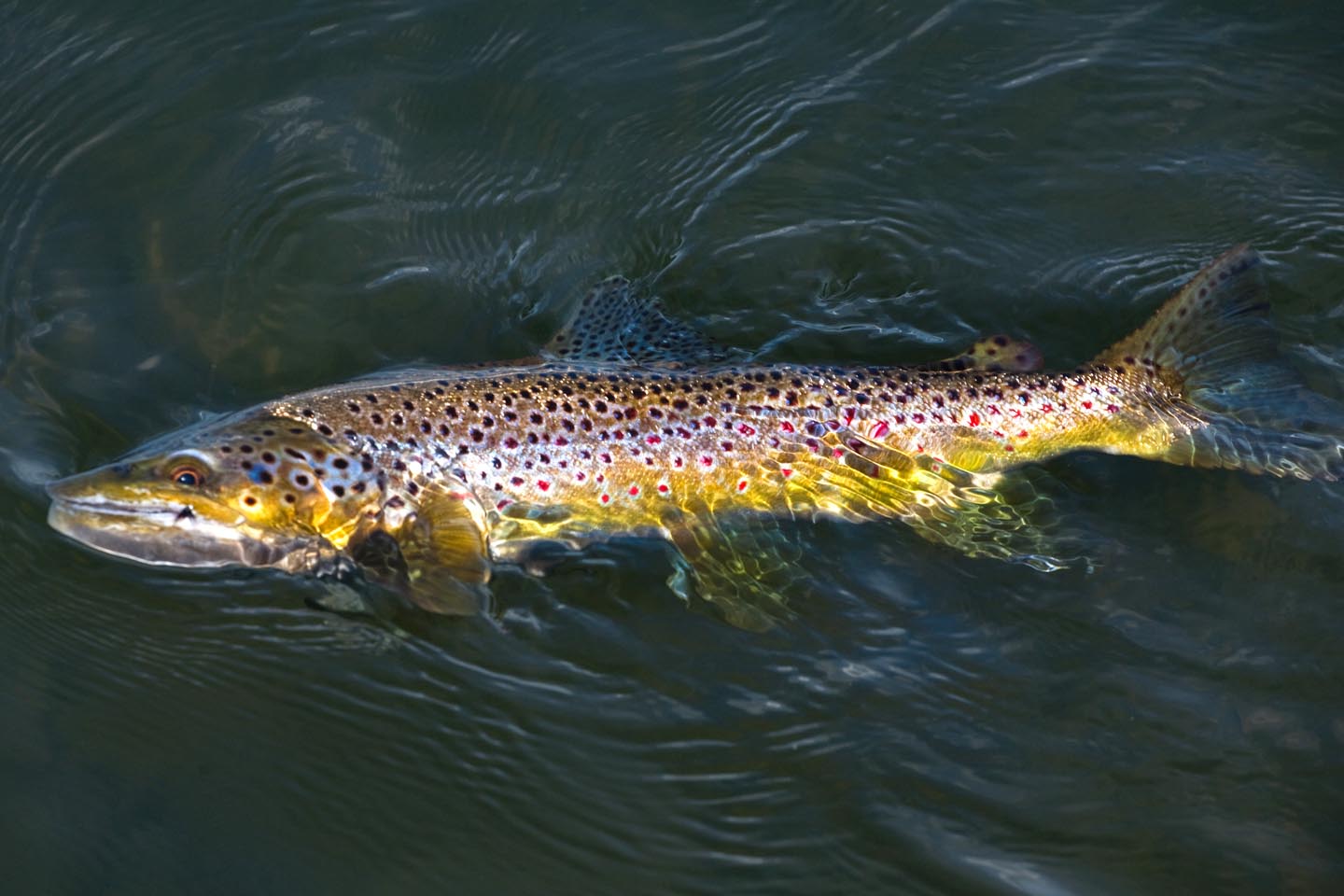
usually a hopper, beetle, or cicada pattern. The browns glow in
the
water like a bar of gold and often you can see them from 100 feet
away
to intercept them. Electric motors are your best friend on these
waters.
Traditional loch style techniques are used on overcast days.
Contrary
to most views the most favoured days on Tasmanian trout
waters are
bright, wind is not so critical because if its calm you
fish the edges
or look for rising fish out in mid water, if its windy
you look for
windlanes or cruisers, if its dull you fish blind loch
style or look
for rising fish.
Peter
~~~~~~~~~~~~~~~~~~~~~~~~~~~~~~~~~~~~~~~~~~~~~~~~~~~~~~~~~~~~~~~~~~~~~~~~~~~~~~~~~~~~~~~~~~~~~~~
Peter : I placed your picture of a beautiful Tassy brown with lots of bright gold coloration in an attachment. No wonder you can spot them at a distance on a sunny day ! You have informed me that the word "Tassy" is short for Tasmania.
Re. your description of windlane fishing : Windlanes or "scum lines" are found usually in shallow still waters including lakes and salt water bays.
Scientists relate their formation to the combination of wind, flotsam and the Coriolis effect of the Earth's rotation. Interesting that they are almost always at 45 degrees to the direction of the wind. The floating debris contains nutrients and harbors forage organisms which in turn attract fish. Along these lines one can see white foam when it is very windy. Beneath the lines of foam and spindrift, there are said to be local circular and spiral currents at and just below the surface rotating in opposite directions. This is probably what holds the flotsam in line. These spiral currents are called "Langmuir spirals".
Some of the scientific Oceanographic papers on the subject make for heavy reading.
Coriolis effect: Physics - An apparent deflection of moving objects when viewed from a rotating reference frame rather than a classic Newtonian inertial frame of reference.
An easy to read description of this phenomenon can be found on pp. 76-77 of Gary Borger's PRESENTATION.
Gordy
~~~~~~~~~~~~~~~~~~~~~~~~~~~~~~~~~~~~~~~~~~~~~~~~~~~~~~~~~~~~~~~~~~~~~~~~~~~~~~~~~~~~~~~
From Paul Arden :
Hi Gordy, there's a fairly extensive stillwater section on SL.
http://www.sexyloops.com/stillwater/index.shtmlIt was written a long time ago in '96. Not much has changed, just the
use of blobs (round colourful egg-like attractor flies - which I don't
fish because it doesn't excite me), the "washing line", which is
buzzers on the droppers and a booby on the point with an intermediate,
and there are a much wider availability of synthetics.
This is how I started FF, like most people in the UK I guess. I spent
all my school holidays fishing one particular reservoir - Ardleigh -
as well as weekends, and a non inconsiderable number of afternoons
when I should have been at school! When I was 16 I started working in
the fishing lodge. That's how I got into instruction, when I was 25 I
was teaching people to fish on the reservoir and casting followed from
there.
A more general, and yet excellent read, is
http://www.sexyloops.com/sparton/stillwaters1.shtmlSteve Parton is one of FF's pioneers, he wrote an excellent book
called "Boat fishing for trout" - OK his titles are about as
imaginative as mine.
The UK stillwater scene is much better now that it was a decade ago.
Most of the major fisheries have embraced the concept of C&R.
Consequently there are more grown on and overwintered fish, and they
appear more inclined to feed top-of-the-water, which is great!
Cheers, Paul
~~~~~~~~~~~~~~~~~~~~~~~~~~~~~~~~~~~~~~~~~~~~~~~~~~~~~~~~~~~~~~~~~~~~~~~~~~~~~~~~~~~~~~~~~~~~~
HORNBERG FLY
~~~~~~~~~~~~~~~~~~~~~~~~~~~~~~~~~~~~~~~~~~~~~~~~~~~~~~~~~~~~~~~~~~~~~~~~~~~~~~~~~~~~~~~~~~~~~~~
Followup on the Hornberg fly a picture of which was sent by Bob Tabbert :
Gordy, Frank Hornberg was a Wisconsin
DNR warden who back in the 30's first tied his 'Hornberg' streamer for fishing
native brook trout in streams and ponds in the Stevens Point/Antigo area of
north central Wisconsin. Bob
Robert L. Tabbert
Conservation, Fly
Fishing,
Exploration
~~~~~~~~~~~~~~~~~~~~~~~~~~~~~~~~~~~~~~~~~~~~~~~~~~~~~~~~~~~~~~~~~~~~~~~~~~~~~~~~~~~~~~~~~~~~~~~~~~~
THERMOCLINES
~~~~~~~~~~~~~~~~~~~~~~~~~~~~~~~~~~~~~~~~~~~~~~~~~~~~~~~~~~~~~~~~~~~~~~~~~~~~~~~~~~~~~~~~~~~~~~~~~~~
From Walter Simberski :
~~~~~~~~~~~~~~~~~~~~~~~~~~~~~~~~~~~~~~~~~~~~~~~~~~~~~~~~~~~~~~~~~~~~~~~~~~~~~~~~~~~~~~~~~~~~~
Walter... As you probably know, finding the deep water thermoclines out in the Ocean is important to the commercial swordfishermen, too. G.
~~~~~~~~~~~~~~~~~~~~~~~~~~~~~~~~~~~~~~~~~~~~~~~~~~~~~~~~~~~~~~~~~~~~~~~~~~~~~~~~~~~~~~~~~~~~~
Attachment:
Tassy Nov '09 low rez-8639.jpg
Description: JPEG image