[Date Prev][Date Next][Thread Prev][Thread Next]
  • Thread Index
  • Date Index
  • Subject Index
  • More on stillwater fishing /


    Walter & Group....

    From Don Pendleton:

    Gordy,
     
    Walter Simberski made a few comments about temperature layers that will form in large still water lakes.  The thermocline that he refers to generally sets up during the late spring months.  The surface water warms ,  a colder layer called the thermo cline forms at about 20 maybe 40' depending on the overall dept, the lake size, surface temperature and lower temperature of the hypolimnion (lowest level of the lake).  Fish activity is generally highest at or slightly above this thermo cline.  Most lakes that I fish will have what we call a turn over twice a year.  Once early in the spring and once in the mid fall season.  The hypolimnion will be cooler and as summer goes on this area gradually loses oxygen.  As I understand it the loss of oxygen is due to lesser amounts of plant life below the 25' dept.  This oxygen is replaced during the fall and spring turnovers that most deep inland lakes and ponds will have. 
     
    Some electronics can locate thermoclines better than others.  The best way is a digital thermometer on a long marked cord.  Once you find the thermocline it will be about 2-5 feet wide. (my experiences).
     
    I suspect there are some Great Lakes salmon guys on here that could explain this better than I have.  Wind can also have big effects on the location and dept of this temperature/oxygen changing layer.  Understanding this you can relate to fishing.  What foods, what organisms, what temperature, oxygen level, all effect the fish activity in a large lake,  all without addressing bottom structure or shoreline habitats. 
     
    Don Pendleton
     
    ~~~~~~~~~~~~~~~~~~~~~~~~~~~~~~~~~~~~~~~~~~~~~~~~~~~~~~~~~~~~~~~~~~~~~~~~~~~~~~~~~~~~~~~~~~~~~~
     
    COMMENTS:   A great deal to learn on the subject of stillwater fishing on lakes on pp. 69 - 79 of Gary Borger's PRESENTATION.
     
    Some of our salt water fly fishers have even gone to the trouble of using underwater video equipement with cameras which can be lowered to depths to visually locate fish.  I suspect that this has been done by some lake (loch / lough ) fishers as well (?)
     
    Gordy
    ~~~~~~~~~~~~~~~~~~~~~~~~~~~~~~~~~~~~~~~~~~~~~~~~~~~~~~~~~~~~~~~~~~~~~~~~~~~~~~~~~~~~~~~~~~~~~~
     
    From Jim Chestnut (I included his attachment)    :
     

    Hi Gordy,

    I am back from my extended trip north and apologise for bringing the Maine

    weather back with me to the Keys. I have been reading all the accumulated

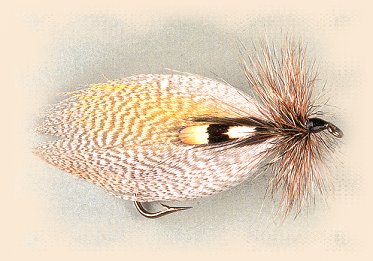
    emails and, in this one, noted that the "Hornberg" was referred to as a

    streamer. Upon searching, it took a long time for me to discover that

    there are many "Hornbergs" out there that do not resemble that which I

    used extensively in Maine in the 1970's. I finally found a picture of the

    "Maine" Hornberg (a picture of which is attached).

    This "Hornberg" I used exclusively dry during the spruce budworm

    infestation of the Rangeley Lakes region during the mid 70's with nearly

    unbelievable success on brook trout. The fly lies flat on the surface film

    with the light wire hook parallel to the water.

    On perfectly flat days fishing small ponds nestled in fir forests,

    properly "tweaked" and fished with a tippet just the right diameter and

    stiffness, the fly will twist the leader when false casting. Upon landing,

    the leader will untwist, making the fly spin around in circles - exactly

    like the live spruce budworm moths landing in the pond. The fly was so

    effective, I almost felt guilty using it.

    Interestingly, the spruce budworms devastated the balsam fir on my

    family's property on that pond, but ate none of the spruce trees. The

    demise of the budworms gave rise to carpenter ant infestations which, when

    they grew wings and swarmed, once again made for fabulous trout fishing

    using ant immitations.

    Just thought you might be interested.

    Cheers,

    Jim

    Attachment: hornberg.jpg
    Description: JPEG image