Walter & Group....
From Ally Gowans . My comments in his text in blue italics. G.:
Hi
Gordy,
Dry fly fishing was
almost certainly practiced before Halford and H S Hall popularised it and indeed
the method was featured in The Field magazine dated Dec 17 1853. Fosters of
Cheltenham sold split wing dry flies as early as 1854. James Ogden another
Cheltenham tackle dealer claimed to be the first to use dry fly during the
1840?s but doubtless others used floating flies before that and perhaps
they were used in other countries where the written evidence is lacking.
Apparently the first trout caught on a dry fly on the R Test was in 1888 but
Thuddeus Norris used dry fly in
Arthur Wood certainly
deserves the credit for developing the greased line method of fishing for
Atlantic Salmon but he most certainly would not have been the first to grease a
fly line.
I also noticed a reference to a ?constant tension? cast. ?Constant tension? would be the same force acting in exactly the same direction at all times. Constant tension during a cast is impossible but in all casts the line is ?constantly tensioned? which is of course means something completely different.
The term I used was CONTINUOUS TENSION, not constant tension. I simply borrowed it from the description in the fly casting literature referring to the European style of casting popularized by Hans Gebetsroither. I look at continuous tension as the maintainence of some degree of tension (different forces) while I'd consider constant tension as tension which remains unchanged. As you point out, "the same force". G.
P.S.
I have a whole presentation devoted to Wood, his astonishing inventiveness and
to Cairnton where he fished on the R
Best
wishes,
Ally
Gowans
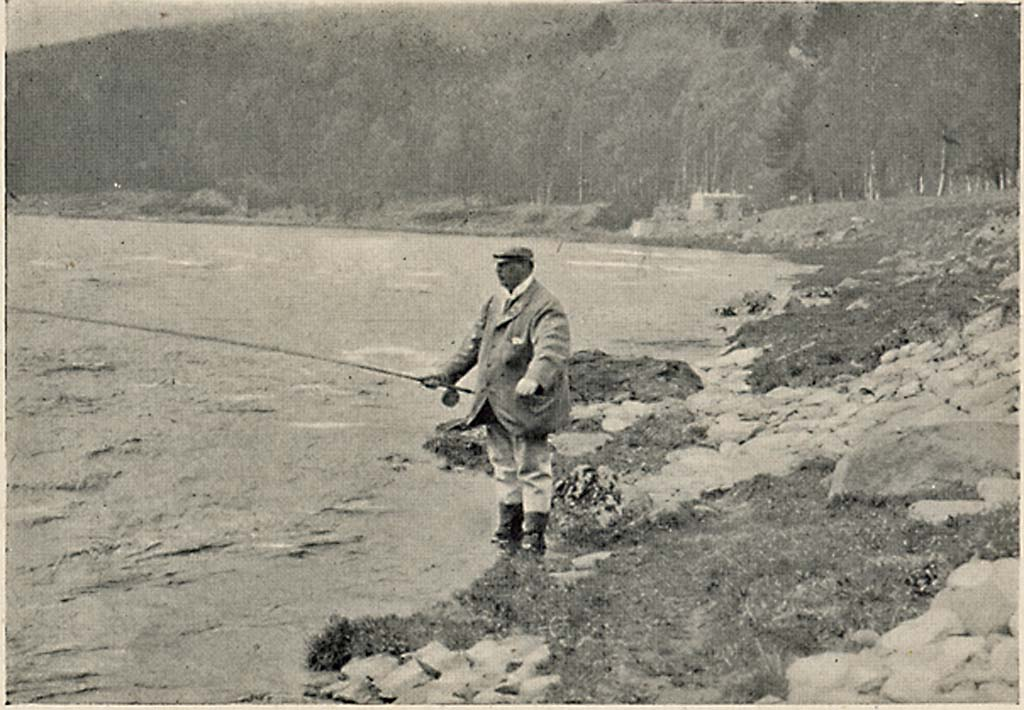
In my previous message a Freudian slip caused me to write Alexander Wood when of course I should have typed Arthur Wood! Below is a picture of Wood fishing, he cast a 12ft built cane rod single handed which sounds taxing but he was a huge man who had to have special almost double width coat-hangers made for his clothes!
Ally
~~~~~~~~~~~~~~~~~~~~~~~~~~~~~~~~~~~~~~~~~~~~~~~~~~~~~~~~~~~~~~~~~~~~~~~~~~~~~~~~~~~~~~~~~~~~~~~~~
Note the attachment ..... a picture of Arthur Wood with his long single handed fly rod. G.
~~~~~~~~~~~~~~~~~~~~~~~~~~~~~~~~~~~~~~~~~~~~~~~~~~~~~~~~~~~~~~~~~~~~~~~~~~~~~~~~~~~~~~~~~~~~~~~~~
Here are Carl Zarelli's answers to historical questions:
~~~~~~~~~~~~~~~~~~~~~~~~~~~~~~~~~~~~~~~~~~~~~~~~~~~~~~~~~~~~~~~~~~~~~~~~~~~~~~~~~~~~~~~~~~~~~~
From Dan Pangaldi. My brief comments in his text in italics. G.:
Gordy,
Great story, I can visualize the whole
thing... you're blessed...Gull Wing Cast...awesome.
I'm assuming
we're casting the heavily weighted flies on a floating line for this
discussion. Yes. G.
Try to
remove the barbs from hooks as a safety measure also.
I use barbless hooks for most fish ... except
tarpon. G.
False casting heavy
flies can be keep to a minimum when a smooth lift water haul (matching
the haul intensity to the lift intensity) is used after a couple
of roll cast pick-ups to get the fly to the surface. You'll have
practically the whole head out of the tip top and be in good position to make
your back cast, slip a few feet of line now having the proper amount of
overhang, form an open loop and make your forward cast. I'm lazy
and lead and tungsten hurt not to mention the hook.
Agree. Roll
casting to the surface, then using a roll cast pickup works for both heavy flies
and sinking lines. G.
Thanks, for the tip on the slow check haul to straighten the leader.
At times I want the leader to straighten for better accuracy when
sight fishing for stripers on wind blown flats with heavy
flies.
Regards,
Dan Pangaldi
~~~~~~~~~~~~~~~~~~~~~~~~~~~~~~~~~~~~~~~~~~~~~~~~~~~~~~~~~~~~~~~~~~~~~~~~~~~~~~~~~~~~~~~~~~~~~~
Dan...
Congratulations on some proper preparation and good fishing !
I do maintain tension on the line during the final back cast unless I use a back cast shoot. Even then, I maintain enough tension to avoid slack as I shoot line through a ring made by the thumb and forefinger of my line hand. (This is something I learned years ago from Lefty Kreh.)
Also.... I maintain control of the line as I shoot it on the forward cast in the same manner. By doing that it accomplishes several things:
1.) Reduces the liklehood of slack which can result in a line tangle as the line shoots up from the deck, water or ground.
One way this works well for me is to put my line hand with the ring made by my thumb and finger DIRECTLY OVER THE CENTER OF THE COILS OF LINE ON THE DECK OR GROUND. That way, the line being shot comes straight up from the coils and not from one side !
(Another trick: If you wish to reel in line from that pile of coils on your deck, do so slowly with your reel placed as close down to deck level as you can and off to one side .)
2.) I have control which allows me to make an immediate check haul if needed. Or abort the cast. I can also change direction during false casting on either my back cast or forward cast if my target (fish) moves.
3.) Allows me to start my strip immediately after the fly lands when that is desired.
4.) One VERY important thing.... I can keep my eye on the fish and not have to search for the line ..
Caveat : I'll admit, once and a while I forget to do this. In order to keep my eye on the fish when I've dropped the line from my line hand, I slide my line hand out on the butt section of the rod to the first stripper guide ...... MY LINE IS ALWAYS THERE ! (I taught myself that trick years ago while striper fishing at night.)
Gordy
~~~~~~~~~~~~~~~~~~~~~~~~~~~~~~~~~~~~~~~~~~~~~~~~~~~~~~~~~~~~~~~~~~~~~~~~~~~~~~~~~~~~~~~~~~~~~~~
From Rene Hesse:
From Dusty Sprague on Mark Sedotti :
Gordy, you might pass the following on to the group.
Mark will be demonstrating his casting technique of those outrageously large flies at our upcoming FFF Florida Council Conclave in Orlando on October 23 and 24.
In addition to Mark we have an excellent line-up of casting events, fly fishing presentations, fly tying demonstrations, equipment manufacturer's displays and instructor certification testing. Join us if you can.
Dusty
~~~~~~~~~~~~~~~~~~~~~~~~~~~~~~~~~~~~~~~~~~~~~~~~~~~~~~~~~~~~~~~~~~~~~~~~~~~~~~~~~~~~~~~~~~~~~
Attachment:
image001.png
Description: PNG image