Walter & Group...
From Capt. Scott Swartz:
|
Gordy,
In dealing with fatigue sometimes I practice 20 to 30 minutes in the
morning and then another shorter session in the evening trying to monitor
fatigue and stopping while doing well. I have a stiff foam grip
hand shaped I use for students in practicing the stop and relax with
the grip. Use it at the computer to build grip rhythm and
strength--nice break. It goes without repeating that a conditioning
program with weights and cardiovascular exercise pays on water
dividends!
With the new requirement of left handed casting, swapping casting
hands in practice is a another way for rest, even alternating days, one
day dominant hand, next day non-dominant hand.
I am now alternating days, practicing spey casting one
day with a two handed rod and single handed rod the next day. I hope
someday that single handed spey casts will be a part of the
testing exams in the future. I see spey casts as part of a
larger bag of presentation casts which can be practiced two handed
with a single handed rod.
I have never have completely accepted the separation between spey
casting and casting--both are rods that load requiring SLP and a
stop. That is my short answer.
Thanks Gordy, the only addiction I have is this e-mail group, love
the learning so to all again thanks for taking the time to share!
Jerry Puckett
~~~~~~~~~~~~~~~~~~~~~~~~~~~~~~~~~~~~~~~~~~~~~~~~~~~~~~~~~~~~~~~~~~~~~~~~~~~~~~~~~~~~~~~~~~~~
Jerry .... For years we did things
like the snap casts, snake rolls and "switch casts" before I even realized
that Spey casting existed.
When giving Master exams, we usually have
the candidate perform basic Spey casts using one handed
rods.
I think Al Buhr may be giving a workshop
on single handed Spey casting at the Loveland
Conclave.
Speaking of caster fatigue: One of
the reasons Jim Greene said he went to two handed rods was that is was
less fatigueing for him to use these as he reached advanced
age.
Gordy
~~~~~~~~~~~~~~~~~~~~~~~~~~~~~~~~~~~~~~~~~~~~~~~~~~~~~~~~~~~~~~~~~~~~~~~~~~~~~~~~~~~~~~~~~~~~~
MOVING TARGETS
~~~~~~~~~~~~~~~~~~~~~~~~~~~~~~~~~~~~~~~~~~~~~~~~~~~~~~~~~~~~~~~~~~~~~~~~~~~~~~~~~~~~~~~~~~~~~~~
Gordy, The balanced flies attachment
would not open for me, did anyone else have any trouble?
When I am practicing my cast in the front
yard my Labrador Bo often wonders through and becomes a
cruising fish that I have to present to! Great
practice.
John MacDiarmid-----
~~~~~~~~~~~~~~~~~~~~~~~~~~~~~~~~~~~~~~~~~~~~~~~~~~~~~~~~~~~~~~~~~~~~~~~~~~~~~~~~~~~~~~
Comment: I sent it to John in
another seperate message. Hopefully this will
work.
I never thought of using a trained dog
! Then I remembered, we did that once with Tom White's
Lab. named LOOP. Great.
G.
~~~~~~~~~~~~~~~~~~~~~~~~~~~~~~~~~~~~~~~~~~~~~~~~~~~~~~~~~~~~~~~~~~~~~~~~~~~~~~~~~~~~~~~~~~~~~~
|
Attachment:
Maverick 004.jpg
Description: JPEG image
|
From: Gordon Hill
[hillshead@xxxxxxxxxxx] Sent: Tuesday, April 14, 2009 3:07 PM To: 'Scott Swartz' Subject: RE: transom netting Scott:
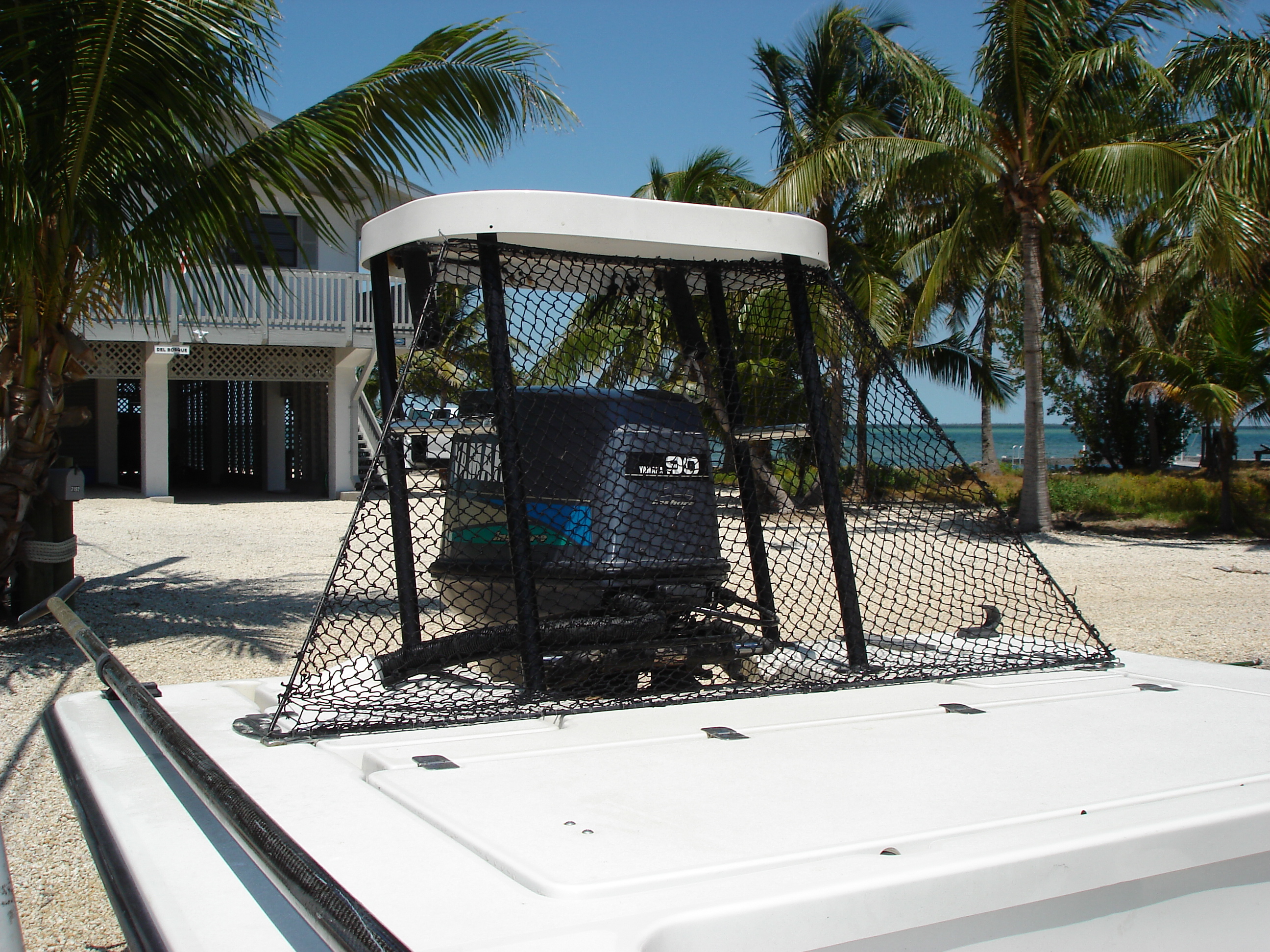
Aft netting to keep your fly line from getting into the
outboard engine and other machinery as you cast from the stern
:
I've bought
it at Standard Marine in Key West. They supplied shrimpers with this
netting. It came on huge rolls 18' wide. I buy 4' of that and have
enough for 4 skiff nets.
Unfortunately, they just went bankrupt. (Sign of the
times.)
I suggest you
contact anyone in the shrimping business in the Tampa area and find out who
supplies them with netting. This is standard 1" nylon mesh. One buys
it by the pound and it is surprisingly inexpensive.
It comes a
yellowish white color. I dye it black using "Rit" dye available in any
grocery store.
Here is how I
make up the net:
1.) I
take these measurements on the skiff ..... Width of my
push-pole platform. Width of the deck to which it will be fastened
at the bottom. Height of the net from deck to the push-pole
platform.
2.) I
make a simple wood frame of the same dimensions and place a brass cup hook at
each of 4 corners.
3.) At
Cudjoe Sales on Cudjoe Key, I purchase 1/4" black neoprene tubing. Also,
stainless steel Hog Rings and Hog Ring plier (It costs about $14.00).
4..)
Now I stretch this tubing around the 4 corner cup hooks on the frame and fasten
to itself with 3 hog rings. THIS MUST BE MODERATELY TIGHT ON THE
STRETCH.
5.) The
dyed netting is now placed LOOSELY ! on top of the frame and
its tubing. The overlap is cut away.
6.) Now
I cut a hundred or so pieces of sail making Dacron twine into 1' pieces and tie
the netting to the tubing by bisecting each segment repeatedly until I have a
tie each 2" all around.
7.)
Next, I load a 3/4" net making plastic needle with all the twine it will
hold. I go all the way around making a lock stitch (just a half hitch)
repeatedly at 1" intervals and tie it off.
8.) I
buy 1" brass S hooks at the hardware store and install them on each of 4
corners, crimping one leg of the S to the rubber.
9.) 4
1/8" holes are made on either side of the push-pole platform cover into which
the top hooks will be placed.
10.) 2
tiny stainless steel straps from West Marine (or any boat supply store)
are installed on the deck below and slightly forward of the push-pole platform,
into which the bottom S hooks will be placed. (open for easy
removal)
FINIS !!!
REMEMBER: THE WHOLE TRICK IS TO HAVE
THE RUBBER TUBING ON THE STRETCH WHILE THE NETTING IS APPLIED VERY
LOOSE. If you fail to do this, the netting will pull the rubber into
funny shapes and lift the bottom off your deck so the fly line may get under
it. Also, it must be loose enough to allow your outboard motor to tilt up
into it without deforming the rubber tubing outline.
For me, this
has been pure magic ! When staked out for poons, I'll get far more strikes
than the guides do when they stake out or anchor from the stern (as most of them
do). One reason is that I don't have the wave slap. This won't
really spook fish, but over the years I've discovered that it tends to make them
wary and a lot less likely to strike.
When bow
tethered, the wind is always blowing aft. The angler retrieves and simply
lets the wind collect the fly line onto the net. Tangles are
rare.
On my
push-pole platform, I have a stand up swivel pole holder. This fits down
into a flush mount rod holder It is REMOVABLE simply by pulling it
out. The angler can rest his fly rod on the platform. I have small
flush rubber loops into which his fly can be hooked.... or he can elect to hook
the fly into the butt cork of his rod. His leader hangs down with some fly
line..... not quite to the water. This way, angler fatigue from holding
the rod for long periods of time is eliminated.
Our waters
are crystal clear and I fish mostly on white skinny water flats ..... sometimes
only 18" to 36" deep.... so I can see fish just fine without standing on a
platform. I spot them from the foredeck.
When fishing
with a well trained buddy, we have this "drill":
My angler
casts directly from the stern to any fish which can be
reached.
In the event
I have to drop off stake-out and pole to the critters, I'll either unteather
from the pole or use a trip lead to free my anchor buoy in a second, As I
do this, my angler makes a cast anywhere, then I go up the port side to the
poling platform while he goes to the bow starboard of my center console and
retrieves line there. HE KNOWS NEVER TO DRAG THE LINE FROM STERN TO BOW IN
OR ON THE SKIFF ! Just takes a few seconds and we're on the ready as I
pole up to the school.
Here is how I
make my trip lead:
My anchor
line has an in-line buoy 2' from the loop at the end. That loop is placed
through either my bow eye or the hollow center of the forward deck cleat.
Into that, I place a 12" long piece of 3/4 PVC which is attached to a cord which
runs along my deck. All I have to do, is to yank that PVC out of the loop
by pulling on that cord and the anchor line is detached.
(If I have
Steve Rajeff as my angler, I rarely have to drop off and go for the fish as you
may imagine !)
One other
advantage: If your cap blows off, it usually catches on the
net.
Gordy
|