[Date Prev][Date Next][Thread Prev][Thread Next]
Thread Index
Date Index
Subject Index
Teaching aids / Tips for our BAG OF TRICKS
- Subject: Teaching aids / Tips for our BAG OF TRICKS
- Date: Mon, 26 Jan 2009 11:13:39 -0500
Walter & Group :-
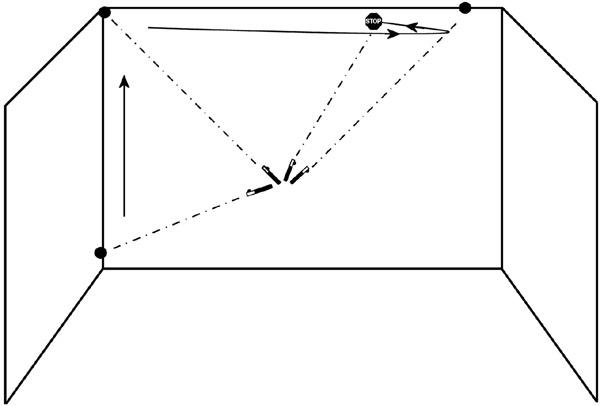
Neat indoor teaching trick by David Lambert (Note
his attachment diagram) :
Gordy-
I'll throw this back into the tricks-toys-and-tools
hopper.
I use and recommend the lazer pen as an inexpensive tool for
diagnosing the cast (both yours' and others'). It's also a strong, very
visual good indoor practice tool. Inexpensive and very visual. I
published a full how-to 10 years ago; attached is a diagram from it. It's
not perfect but you'll get the idea.
Here's a synopsis/how-to:
An
inside tool, have student hold the lazer pen though he/she were holding a rod
handle standing a rod's length from a corner and 4 feet from the casting side
wall. Have student start "cast" with lazer pointing to the floor at bottom
of corner line. Then have them trace the corner line to ceiling line, then
trace the ceiling line back then come forward and back down. (see diagram
of creep with tool)
This tool shows every little off-track motion, every
wobble, every wrist roll, every muscle-induced creep and sloppy stop. One
note: It's very unforgiving. . .but it's pretty useful as a diagnostics
tool.
David
~~~~~~~~~~~~~~~~~~~~~~~~~~~~~~~~~~~~~~~~~~~~~~~~~~~~~~~~~~~~~~~~~~~~~~~~~~~~~~~~~~~~~~~~~~
From Rene Hesse on a simple teaching tool
:
Hello Gordy,
Short answer: Paint Stick
Long answer; Explain how the student is not tracking straight and what it
should look like.
Give them a paint stick and show them how to hold it so when they look in a
mirror they will
only see the thin edge when the make a straight line away from and to the
target.
Give them the stick with these instruction; Place on counter in bathroom
Pick up and very slowly cast back and forth
every day 10 times, for 30 days- do it slow.
This is a cheap 'gift' and great muscle memory tool.
I
will sometimes write 'ssSPP' on it to remind them of the Essentials
that were
taught in the class.
Rene
~~~~~~~~~~~~~~~~~~~~~~~~~~~~~~~~~~~~~~~~~~~~~~~~~~~~~~~~~~~~~~~~~~~~~~~~~~~~~~~~~~~
Rene.... In line with tricks and tools to
help teach good tracking, I'll mention the old "Pizza-box" tool. This was
the bottom cut from a pizza box to which a wooden handle was fastened. To
help teach good tracking, the student "casts" with this to get the feel of
straight tracking as the device cuts through the air with no tendency to twist
and minimal air
resistance.
Gordy
~~~~~~~~~~~~~~~~~~~~~~~~~~~~~~~~~~~~~~~~~~~~~~~~~~~~~~~~~~~~~~~~~~~~~~~~~~~~~~~~~~~~~~~~~~~~~~~~
From Russell Hershberger:
Hello Gordy,
Inverted aluminum pie tins are one of my favorite
targets. They are small enough to really aid in developing accuracy and also
provide an audible "ping" which students seem to like. The loudness
of the ping can be used as feedback for adjusting the
"power" of the presentation.
When searching for Bruce's book "Modern Fly
Lines" I had such trouble finding it that I purchased two copies so that I could
pass one on to any fellow instructor on a similar literary quest. Hence, if
anyone in the study group would like it, I would be willing to part with it at
my cost plus shipping ($35 plus shipping). It's brand new (still in the shrink
wrap). *
I've enjoyed the group's online
discussion.
Regards,
Russell
~~~~~~~~~~~~~~~~~~~~~~~~~~~~~~~~~~~~~~~~~~~~~~~~~~~~~~~~~~~~~~~~~~~~~~~~~~~~~~~~~~~~~~~~~~~~~~~
Russell,
We tried the
pans. Worked well, especially when teaching the use of weighted bonefish
flies where you need the weight but don't want the splash. The idea
is to make an upward curve (vertical curve) so that the fly goes out, then
curves up a bit just as the loop unfurls. Timing is such that the energy
of the cast is dissipated at that point, and the fly descends a short distance
with minimum plop. Much easier to do when casting in an off-horizontal
casting plane. Those plates make a CLANG when the fly lands with too much
speed. (NOT an easy cast to teach even to advanced
casters.)
Problem was that
the light aluminum plates would blow in the wind .... so we placed a
long nail through the center to anchor to the turf. With those aluminum
plates, the noise was not as dramatic as when steel plates were
used.
* To contact Russell about
his copy of MODERN FLY LINES, contact him directly at: rah.cast@xxxxxxxxxxx
..
Gordy
~~~~~~~~~~~~~~~~~~~~~~~~~~~~~~~~~~~~~~~~~~~~~~~~~~~~~~~~~~~~~~~~~~~~~~~~~~~~~~~~~~~~~~~~~~~~~~~~~
I took this one out of
context from a message by Al Crise to his CCI Group. It describes a use
for the video camera which hadn't come up before..... USE BY INSTRUCTORS
TO CRITIQUE THEIR OWN TEACHING. :-
One of the ways to become a better speaker is to
practice speaking just like you are practice casting. If you can listen to a
good instructor you will learn terms and ways of saying that gets the students
casting. It is not enough to just hear. YOU have to say out loud what you want
them to learn. It might seem funny at first.
I taught my dog, cats, even my rod were
there to hear me say the words. WHAT words. I would write out my descriptions of
each task. Then cut that written to few words, with a second section of more
details. Then go out and teach. As
many of you know I am not near anyone that could listen or even hear. So I did
not get feed back. But I stumbled along.
Then I set up my video camera and found out what
it sounded like.
Back to the drawing board so to say....
Al
~~~~~~~~~~~~~~~~~~~~~~~~~~~~~~~~~~~~~~~~~~~~~~~~~~~~~~~~~~~~~~~~~~~~~~~~~~~~~~~~~~~~~~~~~~
Attachment:
lazer-creep.JPG
Description: JPEG image