[Date Prev][Date Next][Thread Prev][Thread Next]
Thread Index
Date Index
Subject Index
Loops - teaching / Fly line backing
- Subject: Loops - teaching / Fly line backing
- Date: Thu, 29 Jan 2009 21:10:11 -0500
Walter & Group...
From Gary Eaton on loops and teaching
:-
Gordy,
Seeing Tom White's masterful statement made me think on his videos
and teaching. The topic brought to mind is the candy
cane shaped loop as an indicator to tell your body to initiate
change of direction.
When the unrolling loop has consumed so much fly leg that the fly line (not
leader) imitates a candy cane or letter "J" lying on its side,
the caster needs to see and recognize this visual
picture. Assuming that it takes a small amount of time from initiating the brain
command to causing the motion intended, the attempt to initiate motion needs to
be triggered before it would ideally start. Hence the candy
cane.
When one recognizes the candy cane, the brain triggers a smooth
transfer from RSP/STOP to translational pull into the opposite casting motion.
By the time the brain conveys this to the hand and the hand secures the grip and
body weight shifts to the point of initiating rod tip movement that affects line
- the fly line and leader may have nearly straightened. This is an ideal place
to reverse the cast.
Bruce might tell us this is 0.02 seconds or something. I suspect there is
considerable variation between individuals. But, recognizing a prescribed shape
of loop evolution is key to perfecting timing. When we recognize this, we
may choose to trust some intuitive timing or
sensation factor and not watch the loop. For learning and understanding this
element, watching the loop is a basic step. Bill Gammel's video Teaching
Yourself to Fly Cast purports watching this loop, too.
My dentist gives out candy-cane shaped ball point pens as a promotion. I
have collected several of them. The first shopping day after Christmas, I go to
the big chain store,or a dollar store, and buy a few candy cane yard ornaments
to use as visual aids in my teaching. They are incredibly inexpensive after
Christmas!
For the group class or rod-in-hand demo, I use the bigger yard ornament
version. After the demo, I have the pen in my pocket to to hold up against the
back cast unrolling as a model for the student to mimic. My usual advisories
include, "longer short part" or "before the short part is that short".
I also make comparisons to a shepherd's crook, the letter "J", and umbrella
handle, a walking cane, etc.
The same retail outlets are good places to pick-up hoola-hoops, flying
discs, etc. If there are any laying around when the snow flies, after Christmas,
they can be pretty inexpensive. I provided my casting partner a "teaching kit"
of hoops, clipboard, anchor post, cones, tape measure, etc when he passed his
CCI. I also gave him a CCI pin from the Federation.
One can buy a 50-meter tape measure or a 100-foot version from discount
tool outlets for a good price compared to name brand stores. I have found that
using a "J" shaped tent stake (from camping department) as an anchor gives the
caster one less thing to kick or wrap line around, compared to a stake or
screwdriver that protrudes above the ground. These "J" stakes can also stabilize
the tape straight on the ground as they are wide enough to wrap around the 1/2
inch wide fiberglass or metal measuring tapes. If placed at proper intervals, a
piece of fluorescent surveyor's ribbon, yarn, or Teflon thread seal tape can be
an effective target marker when pinned by these stakes. An "O"-ring
attached to any target can make it secured more easily by this method. The
mouse trap also makes an effective anchoring clamp.
Gary Eaton, MCCI
~~~~~~~~~~~~~~~~~~~~~~~~~~~~~~~~~~~~~~~~~~~~~~~~~~~~~~~~~~~~~~~~~~~~~~~~~~~~~~~~~~~~~~
Teaching tips and tools from
Al Crise:
Tip for
Teaching
I have a 5 ft 5 wt rod (It
was made for my Great grand son when he was 4 he out grew it) that I use for
demo while talking indoors.
I often have room for this
rod where a 9 ft rod would hit the ceiling.
I have orange line on it
to be easy to see but the Bright hot yellow works just as
well.
This way I have a
large Crayon to color with. Keep my hands busy. stroke, rotation, and Trajectory
can all be shown.
On the folding rule. I
carry one in my teaching bag for demos of Trajectory, Arc and
Dome.
As many of you know I have
a Hat with flies on it. No not just from poor casting did I get them, but it is
great to have several types to show and tell. Clouser,hairbugs. Nymphs,
emergers etc.
I have a 3X2 dry erase
board and colored markers that I carry with me for drawing on. Some need to see
it in stop action.
This I can do with the
drawings.
ol Al
~~~~~~~~~~~~~~~~~~~~~~~~~~~~~~~~~~~~~~~~~~~~~~~~~~~~~~~~~~~~~~~~~~~~~~~~~~~~~~~~~~~~~~~~~`
Al... I remember your 1
foot long rod that you brought to a SE Council meeting several years ago.
As I recall, somebody stole it during the festivities.
Gordy
~~~~~~~~~~~~~~~~~~~~~~~~~~~~~~~~~~~~~~~~~~~~~~~~~~~~~~~~~~~~~~~~~~~~~~~~~~~~~~~~~~~~~~~~~~~~~~~
Note on learning from Tony Loader
:
Hi Gordy,
I'd love to participate in such a conclave
workshop but I'm not likely to be able to get there. May I instead endorse
the comments from Tom Bell and John MacDiarmid. I've learned a lot from
books and web sites but needed to process a lot of dross in order to find the
pearls. Application and experiment provided more epiphanies but re-inventing the
wheel is a slow process. Here, thanks to the generosity of all who contribute
and especially your good self, wisdom comes unadulterated and specifically
targeted. I am grateful for the opportunity to
participate.
Regards,
Tony.
~~~~~~~~~~~~~~~~~~~~~~~~~~~~~~~~~~~~~~~~~~~~~~~~~~~~~~~~~~~~~~~~~~~~~~~~~~~~~~~~~~~~~~~~~~~~
Tony ... I realize, it's a long
and expensive trip from Australia to Loveland, Colorado ! As the FFF grows
with more members and certified instructors, I wonder if we'll someday have an
Australian Council with meetings similar to ours in the
USA...???
~~~~~~~~~~~~~~~~~~~~~~~~~~~~~~~~~~~~~~~~~~~~~~~~~~~~~~~~~~~~~~~~~~~~~~~~~~~~~~~~~~~~~~~~~~~~~~
Line ... Fly line backings
~~~~~~~~~~~~~~~~~~~~~~~~~~~~~~~~~~~~~~~~~~~~~~~~~~~~~~~~~~~~~~~~~~~~~~~~~~~~~~~~~~~~~~~~~~~~~~~
From Bob Rumph on an old time fly line
backing ....CUTTYHUNK :-
Hi Gordy,
You frequently
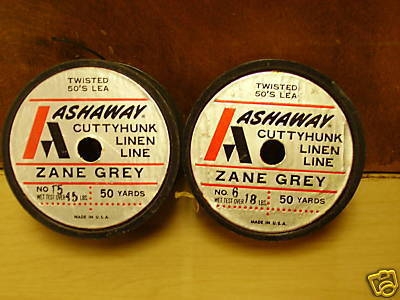
mention Cuttyhunk, I also remember this line from when I was a very
young angler fishing bait casting reels. One of the things I remember, is
how it rotted on the spool. Anyway, here is a picture that should bring
back some memories for you. This company also made silk lines and I have an
original unopened silk line as part of my collection.
Regards,
Bob
~~~~~~~~~~~~~~~~~~~~~~~~~~~~~~~~~~~~~~~~~~~~~~~~~~~~~~~~~~~~~~~~~~~~~~~~~~~~~~~~~~~~~~~~~~~~
Bob, Cuttyhunk
and silk were used for years for bait casting as well as fly line
backings. We used nothing but these when fly fishing back in the 1930's
and 40's until nylon was invented. Cuttyhunk was used as big game trolling
line, too. Both were strong when new and had good knot strength.
Both would rot if put away damp ... especially Cuttyhunk and MOST especially if
wet with salt water ! Testing didn't do much good, because most of the
backing might be just fine..... but there could (and often was) one spot of rot
which served as the weakest link in the "chain" !
When Tom White and I gave our MCCI
prep courses, under the general catagory of FLY TACKLE, we included discussions
on the pro's and con's of various modern available backing materials. I
gave Peter Minnick the task of tabulating the whole thing and he did a fine
job.
In line with that, let's have a
little quiz:
LIST THE ADVANTAGES AND
DISADVANTAGES OF THE FOLLOWING FLY LINE BACKING
MATERIALS:
BRIEF ANSWERS ! Follow each
answer with a more detailed one only if needed for
clarity.
1.) Nylon monofilament, standard
cylindrical cross section.
2.) Nylon monofilament, flat or
oval.
3.) Braided nylon
multifilament.
4.) Braided nylon
monofilament.
5.) Braided
Dacron.
6.) Braided
Kevlar.
7.) Braided
Spectra.
8.) Combined sections of braided
Spectra and Nylon monofilament.
Gordy
Attachment:
Cuttyhunk.JPG
Description: JPEG image