Hi Gordy,
Thought this photo may be of interest to the group with regards to the
mono. These were taken back in the mid 90's when we performed several tests on
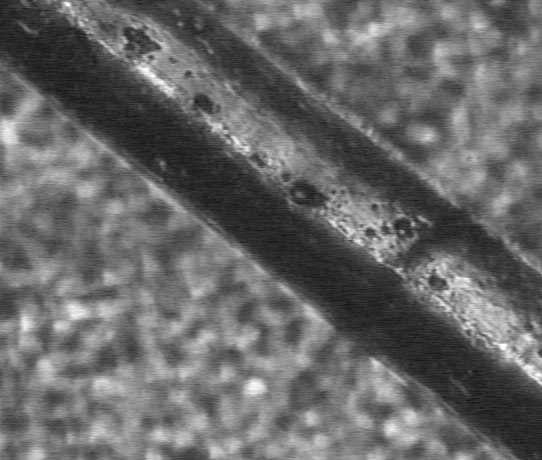
various leader materials. I knew from guiding that the one with pits in it was
junk long before the test took place. I tried to be non biased as thinking that
it must have been a bad batch-wrong it stayed that way for a decade. You could
tie a fly on, moisten the knot, draw it down, and the material would always
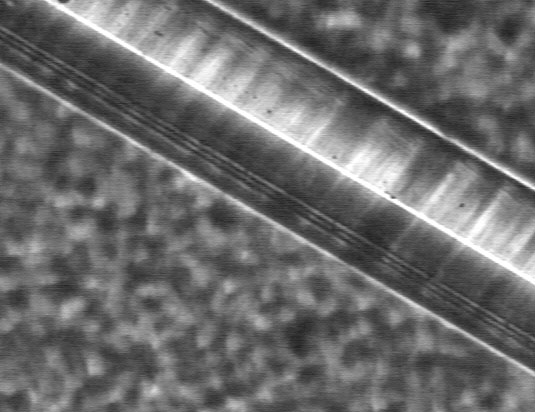
break far away from the knot. The pics illustrate what the strain gauge proved
as well. The clear one (looks like a reflection in a mirror surface) had the
best overall results for breaking strength. The test results used to be on a web
page called Casting Angles. I maintained the site at WCU regarding the testing
of fly lines, leaders, and rods for about a decade. Bruce can
perhaps comment on their superb results of the 3m material. The one with
lacerations failed quickly when dry tested (we can call this "junk brand" to
protect the guilty). The interesting thing from those tests is if a material
already has lacerations, then it fails much quicker when it becomes wet. As well
as making it next to impossible to test knot strengths since it breaks far from
the knots to begin with. An interesting side tidbit was that the material
with lacerations also had an actual breaking strength 52% weaker than
advertised. Buyer beware is right.
It was a bear to find this old pic, but as the adage goes-a picture is
worth a thousand words. The photos were taken for me at Mississippi State
Materials Lab by Ramsey Green in about 1995. This may help Tony as well in
regards to the comment on the hearsays. Lesson to be gained from all of
this is that mono quality varies dramatically from manufacturers.
Cheers,
Mac
~~~~~~~~~~~~~~~~~~~~~~~~~~~~~~~~~~~~~~~~~~~~~~~~~~~~~~~~~~~~~~~~~~~~~~~~~~~~
COMMENT:
This is one reason not to use old abraided or
cheap mono. It is one of our biggest problems when fishing for tarpon,
because the tarpon's mouth, while having no teeth, has an abrasive lining which
will abraid any nylon mono or fluorocarbon quickly.... even to the point that we
occasionally lose a fish despite the use of very heavy bite tippet of 60# or
even 80# material ! Because of this, I'll change bite tippets even after a
tarpon strike with no hookup if I retrieve the fly and feel the roughness of the
tippet surface.
I included Mac's attachments.
Gordy
~~~~~~~~~~~~~~~~~~~~~~~~~~~~~~~~~~~~~~~~~~~~~~~~~~~~~~~~~~~~~~~~~~~~~~~~~~~